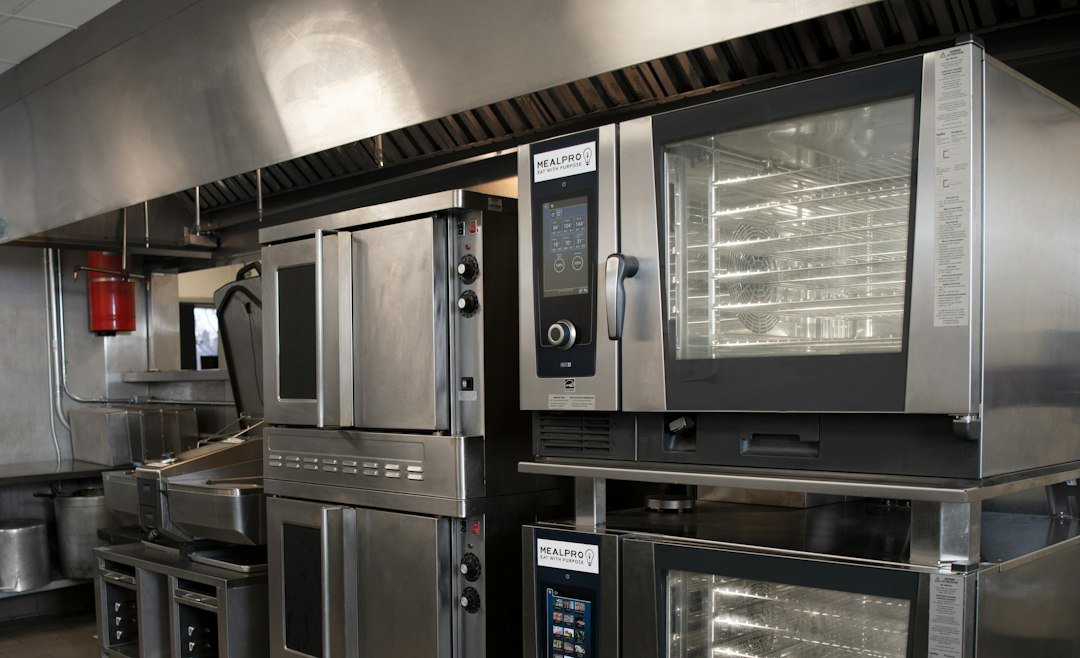
The cheapest monthly equipment payment may be the most expensive five-year decision. For a U.S. restaurant buying a commercial oven, refrigeration line or dishwasher, the comparison should include cash at signing, financing or lease payments, maintenance, installation, taxes and fees, downtime risk, and what happens at the end of the agreement. This guide builds a side-by-side model that makes those assumptions explicit.
All prices and payment figures in this article are hypothetical examples, not live lender quotes. Equipment reliability, lease structure, tax rules and financing terms vary. Obtain written quotes and have significant agreements reviewed by your accountant and attorney.
Lease, finance or buy: they are three different decisions
Cash purchase means you pay the equipment vendor and own the asset, with full exposure to repairs and eventual resale. Financed purchase means you borrow money and usually own or acquire ownership subject to the lender’s security interest; the total cost includes interest and fees. Leasing means making contracted payments for the right to use equipment, often with restrictions on maintenance, early exit, end-of-term return or purchase. Some arrangements marketed as leases function economically like financing, so review the actual contract, not the product name.
The U.S. Small Business Administration describes the usual trade-off: leasing can reduce upfront capital demands but may cost more over the full life, while buying requires more initial funding yet can create ownership and residual value. Neither approach is automatically right for every kitchen.
Five-year cost comparison: commercial kitchen equipment
Assume a restaurant needs a major appliance for 60 months and receives the following illustrative proposals. Both alternatives are assumed to deliver comparable capacity, safety and service quality; otherwise a price-only comparison is misleading.
| Five-year cash-flow component | Buy for cash | Operating lease example |
|---|---|---|
| Equipment purchase price | $20,000 | — |
| Installation and commissioning | $2,000 | $2,000 |
| Initial lease or administrative fee | — | $800 |
| 60 monthly payments | — | 60 × $420 = $25,200 |
| Repair/maintenance paid by restaurant | $4,500 | $1,500 |
| Expected resale proceeds after 60 months | −$4,000 | $0 |
| Illustrative five-year net cost | $22,500 | $29,500 |
Under these assumptions the lease costs $7,000 more over five years in nominal dollars. This is not a reliable answer until you examine what the contract covers. Does the lessor cover major component replacement? Is an inspection or return-shipping charge due? Is there an automatic renewal? Is the resale value realistic? The model excludes financing interest, the time value of cash, income-tax differences and lost production during failure.
Cash flow can matter more than total cost
A new restaurant with $35,000 available for pre-opening costs may not be able to spend $22,000 on one piece of equipment without jeopardizing payroll, deposits and inventory. The lease example demands $2,800 at signing ($2,000 installation plus $800 fee), followed by $420 per month. It protects cash at opening while adding a five-year obligation. The owner should calculate a weekly cash runway under both options, not simply ask which has the lower total cost.
For an opening-wide budget, see Restaurant Startup Costs: Build an Opening Budget. For the operating impact of fixed commitments, pair the equipment decision with a 13-week cash-flow forecast.
What if you finance the purchase?
Replace the purchase price in your cash-flow timeline with down payment, loan origination costs, scheduled principal and interest and any balloon payment. Keep asset cost, interest expense and loan principal separate in accounting; principal repayments consume cash but are not an operating expense. A financed purchase can preserve cash and still be cheaper than leasing, but only after you compare written financing quotes on the same period and service obligations.
Use present value when payment timing differs
For a more disciplined capital decision, discount future cash flows using a rate appropriate to the business’s cost of capital and risk. Do not subtract the entire 60-month nominal payment stream from an upfront price without acknowledging the timing difference. If you cannot estimate a defensible discount rate, report nominal total cost and cash-out-at-signing side by side rather than presenting a false precision.
Which costs owners most often forget?
- Freight and access: lift-gate charges, unloading, stair access, removal of old equipment and electrical/plumbing modifications.
- Commissioning: calibration, permits, ventilation or fire suppression interfaces and training.
- Downtime: emergency rental, lost service capacity, spoiled inventory and overtime while the equipment is unavailable.
- Maintenance: filters, seals, preventive service, refrigerant and labor not covered by contract.
- Contract close: return condition, inspection, late fees, relocation consent, automatic renewal and early termination.
- Residual value: what the unit could realistically sell for after removal and transport—not the original list price.
How to price equipment downtime
Assume refrigeration failure forces a restaurant to stop one menu line for a day. Management estimates 45 orders that would have contributed $9 each after ingredients and variable labor. The lost contribution is 45 × $9 = $405, before food spoilage and emergency labor. It is incorrect to value lost sales at the full menu subtotal, and equally incorrect to ignore the possibility of the breakdown. Quantify the operational consequence of each equipment failure scenario, then negotiate service response commitments and backup plans.
Seven questions to ask every leasing company
- Is the quotation a true lease, a rent-to-own agreement or equipment financing?
- What is the total amount payable, including fees, taxes and any buyout?
- Who pays for preventive maintenance, breakdowns and parts?
- What service response time and replacement provision are promised in writing?
- What happens if the restaurant relocates or closes early?
- What return condition, restoration or freight charges could apply?
- Does the contract renew automatically, and what notice cancels it?
A decision table to use with your accountant
| Decision factor | Buying is more attractive when… | Leasing is more attractive when… |
|---|---|---|
| Expected useful life | Long, stable usage expected | Equipment may become obsolete sooner |
| Cash position | Purchase leaves sufficient runway | Protecting cash is essential |
| Maintenance | Repair capability and costs are predictable | Documented service coverage reduces downtime risk |
| Business flexibility | Location and menu are stable | Contract allows practical upgrading or return |
| End value | Meaningful resale market | Disposal and resale are burdensome |
Common mistakes
Comparing rent with depreciation: these are different accounting concepts; examine actual cash outflows and contract obligations. Ignoring personal guarantees: a business financing agreement may put owners at risk beyond the equipment. Assuming tax deductibility: lease and purchase treatment can differ, including financial-reporting classification, Section 179 considerations and state rules. Ask a qualified adviser before relying on any tax saving.
Frequently asked questions
Is buying always cheaper than leasing?
No. It can be cheaper over a long life, but repairs, residual value, service inclusions and the time value of cash can change the result.
Should I lease equipment for a brand-new restaurant?
Possibly, if opening cash preservation matters and the lease terms are manageable. Run a low-sales scenario to test whether fixed monthly payments remain affordable.
How often should equipment costs be reviewed?
At purchase, annually during budgeting, after major repairs and before renewal or replacement. Use our restaurant equipment maintenance checklist to capture service history that improves future cost estimates.
Reference and methodology
U.S. Small Business Administration: Manage your business, lease-versus-buy guidance. The five-year case is an original numerical example for decision training, not a dealer quote or a claim about average restaurant equipment prices.
Featured photo: Andy Sartori / Unsplash.