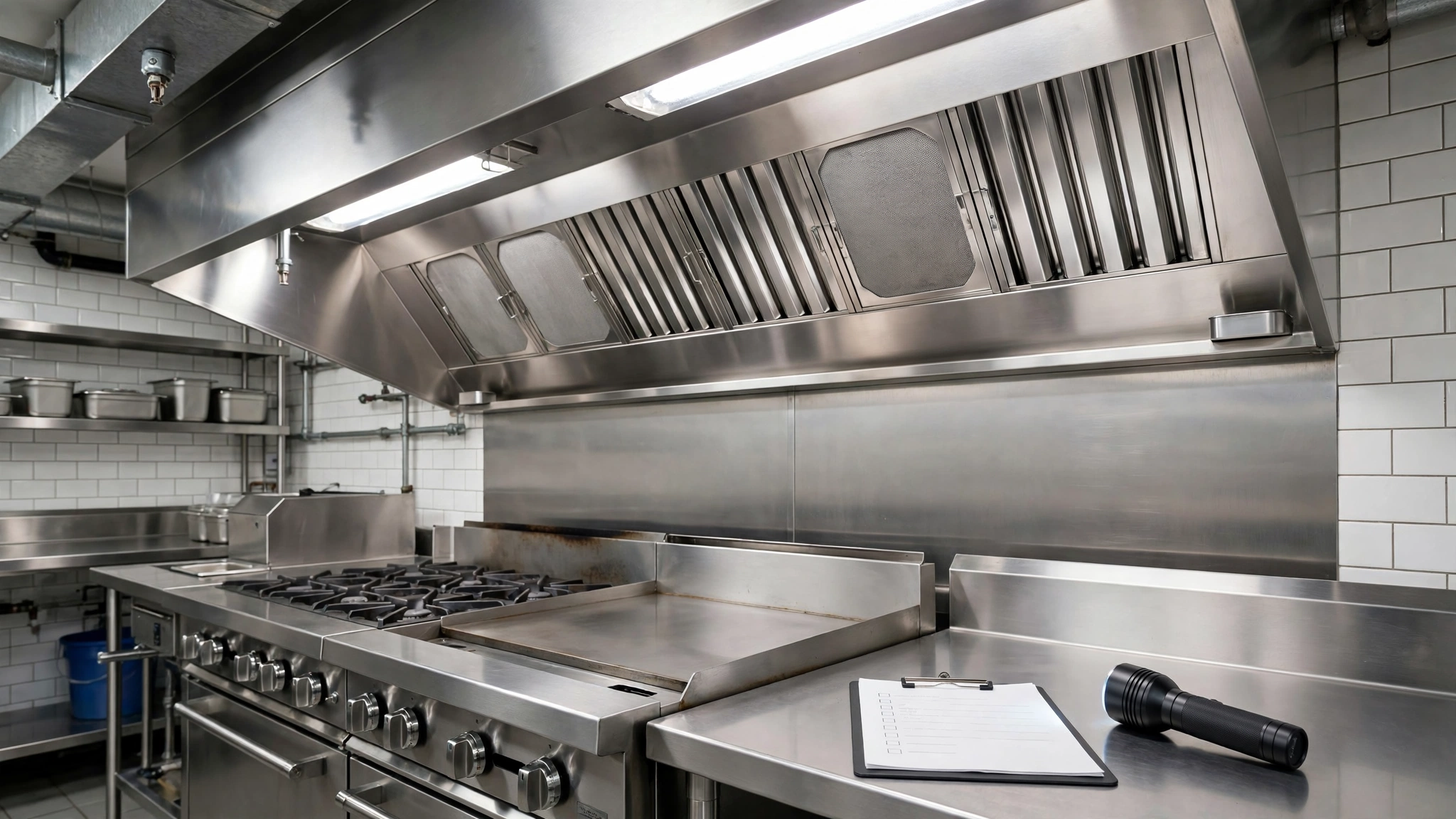
The operator’s role is inspection and coordination, not fire-system service
A commercial hood system sits at the intersection of grease control, airflow, heat removal and fire protection. Restaurant managers have an important role, but it is mostly observational: keep filters and accessible surfaces on the approved cleaning schedule, recognize abnormal airflow or grease accumulation, protect clearances, document service and call qualified professionals for work that belongs to the hood, duct, fan or suppression system.
This boundary matters. A strong maintenance routine helps the operator detect deterioration early without encouraging staff to disassemble, bypass or modify safety equipment.
Operator triage: observe, contain or escalate
| Condition | Manager action | Escalation |
|---|---|---|
| Routine grease or dirty accessible filter | Use the approved cleaning procedure and record completion. | Escalate if buildup returns unusually quickly or extends beyond staff-accessible areas. |
| Smoke capture changes under normal load | Record which appliances are running and verify operator-level items only. | Qualified ventilation service if the condition persists or worsens. |
| New noise, vibration or electrical odor | Reduce risk according to site procedure and document the symptom. | Stop/limit affected operation as required and call qualified service. |
| Suppression-system concern | Follow the restaurant’s fire-safety procedure. | Immediate qualified fire-system service; staff should not modify the system. |
- Identify the symptom and operating load.
- Separate staff-cleaning issues from technical equipment issues.
- Record the last professional service date.
- Assign a named owner for the vendor call or corrective action.
- Verify the original symptom under a comparable load before closing the issue.
What a healthy hood should feel like during service
Operators can learn the normal baseline: smoke and cooking vapors are captured at the hood, the kitchen is not unusually smoky, doors are not difficult to open because of severe pressure imbalance, and there is no new rattling, scraping or vibration from the exhaust system. Changes from that baseline are useful evidence even before the exact technical cause is known.
Capture problems may come from filters, fan performance, make-up air, duct condition, equipment position or building pressure. Managers should record the symptom and operating conditions rather than guessing at the mechanical fix.
First five minutes when capture changes
- Protect the operation: follow the restaurant’s approved response if smoke, heat or a safety condition is affecting people or equipment.
- Freeze the evidence: note which appliances are running, current cooking load, filter condition and whether doors or make-up air changed.
- Check only operator-level items: confirm removable filters are seated correctly and that no obvious operating obstruction exists.
- Do not improvise a repair: do not alter fan controls, suppression components, electrical parts or ductwork outside the approved operator role.
- Escalate with context: send the service provider the exact symptom, time, equipment load and any recent service or cleaning history.
For example, “smoke escapes the front edge only when the charbroiler and fryer are both heavily loaded; filters are seated and were cleaned yesterday” gives a technician a much better starting point than “hood weak.” The manager’s job is to make the failure reproducible enough that qualified service can investigate the real condition.
Example of an incident note a technician can use
| Field | Illustrative entry |
|---|---|
| Time / load | 7:10 PM, charbroiler and fryer at peak production |
| Observed symptom | Smoke escaping front edge of hood for several minutes |
| Operator checks | Filters seated, no obvious obstruction, same equipment position as normal service |
| Immediate action | Manager followed site procedure to reduce risk and recorded the affected line |
| Service context | Filters cleaned previous day; last professional service date attached to ticket |
| Verification plan | Recheck capture under comparable peak load after qualified service |
The numbers and timing above are illustrative, not operating limits. The point is to show the level of evidence that turns a vague complaint into a reproducible service condition. Managers should use the site’s own safety procedures, required service intervals and qualified providers.
Grease control begins with filters and exposed surfaces
Follow the hood manufacturer, cleaning contractor and local fire-code requirements for filter type, orientation and cleaning frequency. Staff should not substitute unapproved filters or operate with filters removed. During routine checks, look for bent or missing filters, heavy visible accumulation, gaps, grease dripping and cleaning practices that spread residue onto hot equipment or electrical components.
The appropriate frequency depends on cooking volume and grease production. High-volume frying and charbroiling can require much more frequent attention than light-duty cooking. Use actual accumulation and required service intervals rather than a generic calendar alone.
Professional hood and duct cleaning is a different layer
Accessible daily cleaning does not replace professional exhaust-system cleaning. Pair hood observation with the broader restaurant equipment maintenance checklist so ventilation stays on the same preventive calendar as other critical assets. Ductwork, fan assemblies and other areas may accumulate grease that line staff cannot safely access. Keep current service records and know the next scheduled inspection or cleaning date. If a contractor identifies inaccessible areas, damaged components or unusual accumulation, record the corrective action and completion evidence.
Do not ask employees to climb roofs, enter ducts or disassemble exhaust fans as part of routine cleaning. Those tasks carry fall, electrical, fire and equipment hazards and should be handled by qualified providers under site policy.
Make-up air and kitchen pressure matter
An exhaust fan removes a large volume of air. The building must replace that air in a controlled way. Symptoms of imbalance can include strong drafts, exterior doors that resist opening, smoke escaping the hood, uncomfortable hot or cold zones and unpredictable capture when HVAC equipment changes state. Managers should note when the symptom occurs—during certain fans, with certain doors open, or only at peak cooking load.
Pressure problems can involve multiple building systems. Escalate persistent issues to qualified HVAC or kitchen-ventilation professionals rather than solving them by propping doors open or changing fan settings without approval.
Daily, weekly and contractor controls should not be mixed
Daily: visual filter condition, obvious grease, capture symptoms and unusual noise. The same daily discipline that supports a walk-in cooler inspection also keeps hood symptoms from becoming tomorrow’s emergency. Weekly or scheduled in-house: approved deeper cleaning of accessible hood surfaces and verification that service labels/records are current. Professional: duct, fan, rooftop and suppression-related service according to code, manufacturer and contractor requirements.
Separating these layers prevents two common failures: assuming the contractor handles every daily condition, or pushing staff into technical work that is outside their training.
Shutdown and escalation triggers
Stop and escalate conditions that suggest immediate fire, electrical or equipment risk according to site procedures. Examples include smoke not being captured, fire-suppression impairment or discharge, electrical burning odor, severe vibration, visible mechanical damage, grease dripping onto hot surfaces or an exhaust fan that is not operating when required for cooking equipment.
The exact shutdown decision must follow the restaurant’s fire-safety plan, equipment requirements and local authority rules. When uncertain, protect people first and involve qualified service or emergency resources.
Maintenance record that actually helps
Record date/time, observed condition, cooking load, affected hood or appliance line, immediate containment, person notified, contractor ticket and closure date. For recurring airflow complaints, add whether exterior doors, make-up air or adjacent HVAC equipment were operating. This context is much more useful to a technician than “hood not working.”
Keep service documentation accessible for managers and inspections. A sticker on the hood is useful, but a central maintenance log makes repeat defects and overdue service visible.
Example: smoke escape only during peak grill load
At low load, capture looks normal. During the dinner rush, smoke begins to roll from the front edge of the hood. The manager confirms filters are installed correctly and notes the symptom is strongest when the grill and fryer are both heavily loaded. Rather than adjusting equipment or fan controls, the manager logs the condition, reduces the risk according to site procedure and calls the ventilation service provider with the load pattern. That information gives the technician a much better starting point.
The example is about observation and escalation, not technical diagnosis.
Illustrative case: a symptom that returns after service
Consider a grill line where capture appears normal most of the week, but smoke rolls from the front edge during the heaviest Friday and Saturday periods. The contractor cleans the system and the next light service looks fine. A manager could close the ticket at that point, but the original failure happened under a different load. Instead, the restaurant records the service date and deliberately observes the next comparable peak while using the same approved equipment setup.
If the symptom returns only when the grill and fryer are both heavily loaded, the manager documents which appliances were running, whether filters were correctly installed, whether doors or make-up-air conditions were unusual and how long the symptom lasted. That evidence goes back to the qualified ventilation provider. The restaurant has now separated “service completed” from “problem verified as resolved.”
The same logic applies to recurring vibration or door-pressure complaints. A good closeout note should answer three questions: did the original symptom reappear, under what operating condition, and what is the next responsible escalation? This keeps the manager inside the safe operator role while making each service call more useful than a vague report of “the hood still feels wrong.”
Operator checklist
- Filters present, seated and not visibly overloaded.
- Accessible hood surfaces free of abnormal grease accumulation.
- No grease dripping toward hot surfaces.
- Normal capture under current cooking load.
- No unusual fan noise or vibration.
- Make-up air/door-pressure symptoms not abnormal.
- Professional cleaning/service status current.
- Suppression system indicators and clearances appear normal according to site procedure.
- Any defect documented and escalated.
Common mistakes
- Running equipment with filters removed “temporarily.”
- Treating visible hood cleaning as equivalent to duct cleaning.
- Ignoring pressure symptoms until smoke becomes severe.
- Using unqualified staff for rooftop or suppression-system work.
- Failing to document repeat vibration, noise or capture complaints.
- Scheduling service by calendar only without considering actual grease load and required intervals.
FAQ
Q: How often should hoods be professionally cleaned? A: Frequency depends on cooking type, volume, local code and the qualified service inspection; use the required schedule for your operation.
Q: Can staff clean filters? A: Often yes if the manufacturer and site procedure allow it and employees are trained, but technical exhaust and suppression work is different.
Q: What does make-up air do? A: It replaces air exhausted by the hood and helps maintain workable building pressure and capture performance.
Q: Should managers adjust fan settings? A: Not unless the system is specifically designed for operator control and the procedure is approved.
Pre-service ventilation release check
- Confirm all required filters are present, correctly seated and free of abnormal visible grease accumulation.
- Start the approved ventilation system and compare sound, vibration and airflow behavior with the restaurant’s normal baseline.
- Confirm no obvious hood, duct-access, suppression or clearance issue is present that requires qualified service.
- Review any open contractor recommendation or unresolved symptom from the previous shift before high-load cooking begins.
- If capture, odor, noise, heat or pressure is abnormal, follow the site safety procedure and escalate before treating the condition as normal operation.
The line is released only when operator-level checks are normal or an identified issue has been handled under the site’s approved safety and service process. This keeps the manager’s role concrete: inspect, document, restrict operation when required and hand technical work to qualified providers.
Coordinate ventilation checks with equipment changes
Moving a fryer, adding a charbroiler or changing cooking volume can alter the load the hood must capture. Do not assume the existing ventilation arrangement remains adequate after equipment or menu changes. Involve qualified designers, service providers and authorities where required before relocating or adding grease-producing equipment.
Document equipment changes in the maintenance file so future technicians understand why capture conditions changed. A ventilation complaint that starts after a menu or line-layout change is important diagnostic context.
Protect fire-suppression access and inspection status
Keep nozzles, pull stations and required clearances unobstructed according to the installed system and local requirements. Managers should know how to recognize obvious damage or missing inspection/service status and who to contact, but suppression testing, modification and recharge belong to qualified providers.
Include suppression status in the same maintenance calendar as hood cleaning without treating the two services as interchangeable. One addresses grease and airflow; the other is a life-safety system with its own inspection requirements.
Additional operating detail
Kitchen ventilation also affects comfort, energy use and equipment performance. A system that is out of balance can create hot zones, drafts or excess conditioned-air loss even when it still captures most smoke. Those symptoms deserve documentation because they may explain staff discomfort or unusual HVAC load. The operator should still avoid technical adjustments without qualified guidance; the job is to make the operating pattern visible.
After professional service, verify the symptom that triggered the call rather than closing the ticket only because an invoice arrived. If smoke capture, vibration or door pressure was the original complaint, observe the kitchen under a comparable load after service. This simple acceptance check helps the restaurant distinguish completed work from resolved work.
Define the operator–contractor boundary clearly
Hood and ventilation control fails when routine observation is confused with specialized service. Restaurant staff can keep exposed surfaces and approved filters clean, notice unusual grease accumulation, check that removable parts are seated correctly, record abnormal noise or airflow symptoms and make sure professional cleaning and inspection occur on schedule. They should not improvise repairs on fire-suppression components, electrical controls, duct interiors or other systems that require qualified providers. Write those boundaries into the maintenance plan so a well-intentioned employee does not turn a daily check into unsafe technical work.
Use symptoms as evidence for the service contractor. Lingering smoke after normal cooking, doors that suddenly become difficult to open, excessive heat at one station, persistent odor, condensation or a marked change in hood noise do not prove a particular fault, but repeated observations are useful. Record what equipment was running, whether filters had just been cleaned, whether make-up air was operating and when the symptom occurred. Keep contractor reports with the asset record and assign an owner and due date to recommended corrective work. A service report that is filed but never closed is not a completed maintenance control.
Connect ventilation maintenance to production planning
Ventilation work can affect operating capacity, so schedule professional cleaning, inspection and repair with the production calendar in mind. A deep-clean or service visit may make certain cooking equipment unavailable, require cooling time or create access restrictions around the line. Record those constraints when the appointment is booked and decide how the menu or prep plan will operate during the service window. After the work, confirm that removable filters, access panels and any operator-visible components are returned to the expected condition before normal production resumes. If the system behaves differently after service—noise, airflow, heat or door pressure—document it promptly rather than waiting for the next scheduled visit. Coordinating maintenance with production prevents the restaurant from treating a safety-critical system as an isolated facilities task and reduces the temptation to postpone necessary work because the kitchen was not prepared for the downtime.
Keep proof of service accessible
Maintain the current cleaning and inspection records where managers can retrieve them quickly, including provider name, service date, scope and any follow-up recommendation. The value is operational as well as compliance-related: when a new noise, grease pattern or airflow concern appears, the manager can see what was last serviced and whether a previous recommendation is still open. That context can shorten troubleshooting and prevent unnecessary repeat work.
Additional topic-specific operating notes
- grease accumulation addressed through the approved cleaning program
- fans, lights and controls observed for abnormal behavior
- staff instructed not to bypass, modify or improvise around safety systems
- define what staff may inspect and clean safely
- place hood checks inside opening and closing routines
- log abnormal noise, smoke capture or airflow symptoms
- escalate faults instead of compensating with unsafe workarounds
- schedule professional cleaning and inspection based on requirements and operating conditions
A line starts feeling unusually hot and smoke capture looks weaker than normal. The correct response is not to remove filters or alter equipment during service. The manager limits risk, logs the symptom, checks only approved operator-level items and escalates to the responsible service provider.
Useful next resource
Ventilation issue triage for operators
Operators should separate what can be checked during routine management from work that belongs to qualified service. The objective is to identify risk early, preserve evidence and avoid normalizing a system that is no longer performing as expected.
| Observation | Manager-level check | When to escalate |
|---|---|---|
| Visible grease buildup on accessible surfaces | Confirm cleaning schedule, responsible party and last completed service. | Buildup extends into areas requiring professional access or the required cleaning interval has been missed. |
| Smoke or heat is not being captured normally | Confirm the hood is operating and no obvious obstruction or operating change explains the symptom. | Capture remains poor, staff experience smoke exposure or the condition worsens. |
| Unusual vibration, noise or odor | Document when it occurs and which equipment is running. | The symptom persists or suggests fan, motor, electrical or fire-safety involvement. |
| Fire-suppression or duct issue is suspected | Follow the site’s approved emergency and shutdown procedure. | Immediately; do not improvise technical repairs. |
Maintenance record that helps the next service visit
- Record the symptom and exact location.
- Note the equipment operating at the time.
- Attach the last cleaning or service date.
- Record any temporary operational restriction.
- Confirm who owns the vendor call and when the condition will be rechecked.
A strong record lets the service provider diagnose faster and gives management evidence that repeated ventilation problems are being addressed instead of absorbed into normal operations. The restaurant should never use a checklist as a substitute for required professional hood, duct, fire-suppression or electrical service.
Monthly operator review for hood and ventilation
Routine cleaning and technical service should be connected by one simple management record. Each month, review the condition history, service dates and any operating symptoms so repeated issues are escalated before they become normal.
| Review item | Evidence | Management decision |
|---|---|---|
| Cleaning completion | Internal cleaning log and professional service record where required | Confirm next due date and close any missed interval. |
| Capture performance | Notes on smoke, heat or odor escaping the hood | Escalate persistent change to qualified service. |
| Equipment interaction | Which appliances were operating when symptoms appeared | Check whether a specific production condition triggers the problem. |
| Fan/noise/vibration history | Date, duration and frequency of unusual symptoms | Schedule service before the symptom becomes a service interruption. |
| Documentation | Vendor report, completed work and unresolved recommendation | Assign one owner for any follow-up item. |
Do not normalize these repeated exceptions
- Staff routinely opening doors because heat or smoke is uncomfortable.
- Grease accumulation returning unusually quickly after cleaning.
- A fan that needs repeated resets or produces changing noise.
- One appliance consistently overwhelming capture during normal use.
- Service recommendations being deferred without an owner or due date.
These patterns indicate that the system needs investigation, a production adjustment or qualified technical work. The operator’s role is to recognize the pattern, preserve evidence and escalate it—not to improvise repairs on ventilation, fire-suppression, gas or electrical systems.
Use the Restaurant Operator Lab tools and related guides only when they directly support the decision described above. Open the free tools library