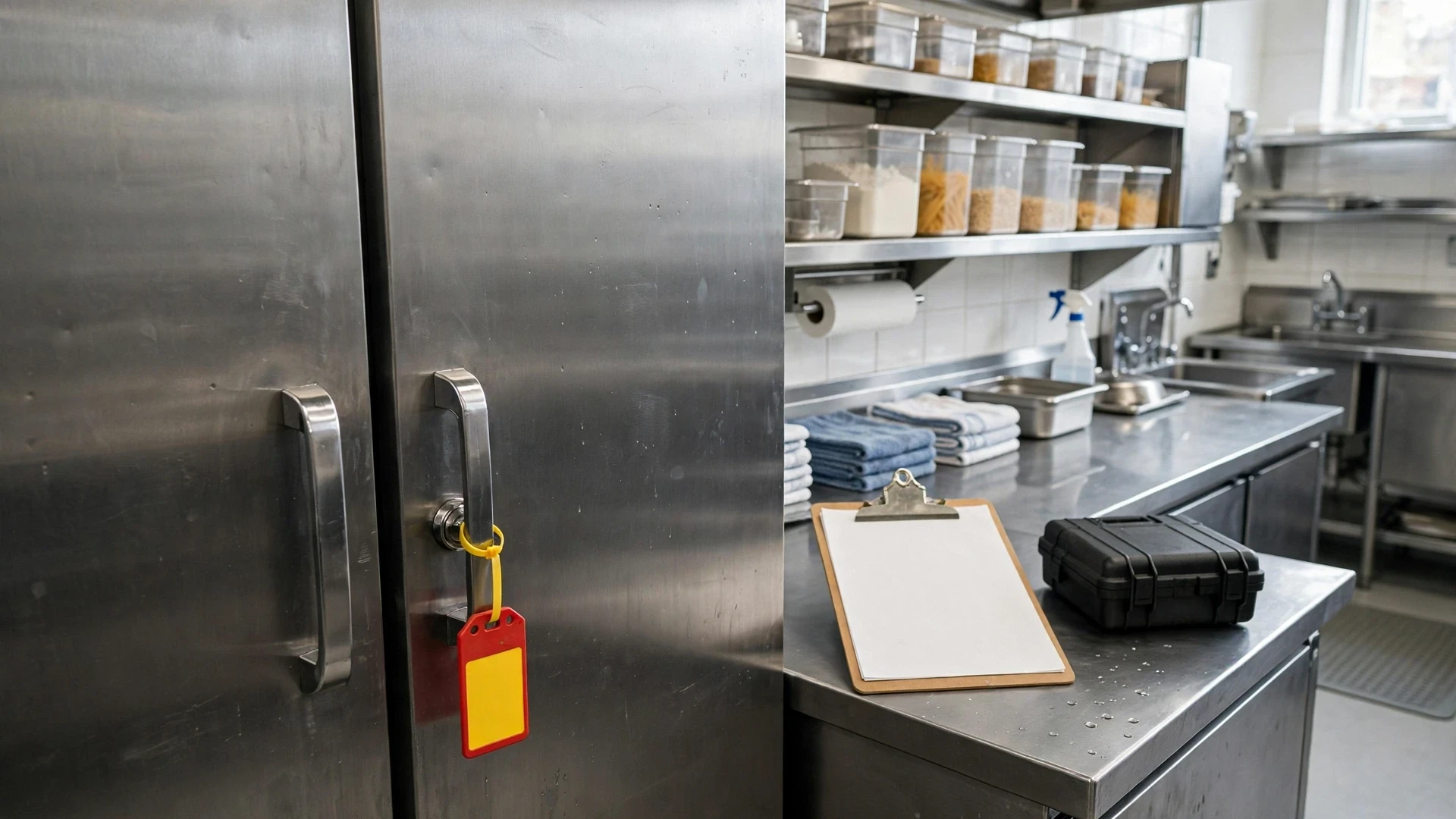
Restaurant equipment problems often live in the worst possible system: memory.
A refrigerator door seal is weak, a prep-table caster is damaged, a dishwasher leaks occasionally, an oven igniter is unreliable, or an ice machine makes an unusual noise. Someone mentions it during a rush. A manager says they will call service. The next shift does not know whether the problem was reported, whether it is safe to use, whether a technician is scheduled or whether the repair was completed.
A maintenance work-order system turns those informal reports into a controlled queue: reported, assessed, assigned, repaired, verified and closed.
Separate a work order from a preventive-maintenance schedule
Preventive maintenance is planned work performed on a defined cadence. A work order is a specific request triggered by a defect, failure, inspection finding or service need.
The two systems should connect, but they answer different questions.
| Control | Primary question |
| Preventive maintenance schedule | What planned maintenance is due before failure? |
| Work order | What specific problem exists now, who owns it and when will it be closed? |
Maintenance guide: Restaurant Equipment Maintenance Checklist: Prevent Breakdowns Before Service
Create one entry point for equipment problems
Employees should know exactly where to report a problem. It can be a maintenance app, shared form, logbook or controlled spreadsheet. The tool matters less than eliminating scattered notes and private messages.
A useful work-order intake captures equipment, location, problem, time discovered, immediate operating effect and reporter.
Use equipment IDs
Names such as “the small fridge” become ambiguous in a busy operation. Give important assets a simple ID, for example WALKIN-01, FRYER-02 or DISH-01. The ID can connect the work order to purchase date, model information, prior repairs and replacement planning.
Classify urgency by operating consequence
Do not let the loudest complaint automatically become the highest priority. Build restaurant-specific urgency levels.
| Priority | Typical operating response |
| Critical | Potential safety, major refrigeration, electrical, gas, fire-protection or complete production failure: stop or isolate equipment as required by approved procedures and escalate immediately to qualified personnel. |
| High | Major service or capacity impact with limited workaround. |
| Routine | Equipment still usable but defect needs repair before it worsens. |
| Planned | Cosmetic, low-impact or improvement work that can enter the normal maintenance schedule. |
This is an operating framework, not technical repair guidance. Employees should not diagnose or repair equipment beyond their training and authorization.
Define the safe-status field
Every open work order should tell the next shift whether the equipment is in service, restricted, isolated/out of service, or awaiting assessment. That status prevents a red tag, verbal warning or temporary workaround from disappearing at shift change.
Record the business impact
- Station or menu items affected.
- Lost capacity.
- Temporary workaround.
- Product-transfer requirement.
- Extra labor or cleaning.
- Service interruption.
- Potential spoilage exposure that must be handled under the restaurant’s food-safety procedure.
- Whether outside service has been contacted.
Assign one owner even when a vendor performs the repair
A technician can own the technical task, but a restaurant manager still needs to own the work order. That owner confirms access, follows up on timing, communicates operating restrictions and verifies completion.
Keep troubleshooting notes factual
Useful notes describe observable conditions: leak under left side, fan not running, display error code, temperature reading under the restaurant’s approved monitoring process, unusual vibration, breaker tripped.
Avoid amateur diagnoses such as “compressor is dead” unless a qualified person has actually determined that. Poor diagnosis can waste time and create unsafe repair attempts.
Link the repair to cost
Capture service-call cost, parts, labor and other directly attributable repair cost when available. Over time, repair history helps management decide whether the asset is still worth maintaining.
Replacement planning: Restaurant Equipment Replacement Planning: Decide When to Repair, Replace or Retire Kitchen Equipment
Use a simple work-order status flow
1. Reported — issue entered with equipment ID and operating effect.
2. Assessed — manager confirms urgency and safe operating status.
3. Assigned — internal qualified person or outside vendor owns the repair task.
4. Scheduled/in progress — service timing is known.
5. Repair completed — technical work is reported complete.
6. Verified — restaurant confirms the equipment performs as expected under normal operating checks.
7. Closed — cost, notes and final status are recorded.
Do not close a work order because the technician left
Completion and verification are different. A technician may replace a part, but the restaurant still needs to confirm that the original operating problem is resolved and any temporary restriction can be removed.
Verification can include an authorized functional check, normal startup, leak check, stable operation or whatever the manufacturer and qualified service process require.
Track repeat failures
If the same asset receives multiple work orders for the same symptom, the manager should see that pattern. Repeat failures can justify deeper service, process change or replacement analysis.
A work-order system becomes much more valuable when it can answer: which five assets generated the most downtime, repair spend or service interruptions this quarter?
Example: the leaking dishwasher
An employee notices water under the dishwasher during closing. Instead of leaving a note saying “dishwasher leaking,” the work order records equipment ID, exact location of visible water, whether the unit was taken out of service under the restaurant’s procedure, photos where appropriate, and who was contacted.
The next morning manager sees the status immediately. After qualified service, the manager verifies normal operation and closes the order with the repair reference. The issue no longer depends on one employee remembering the story.
Connect work orders to preventive maintenance
A repair can create a new maintenance action. If scale buildup, dirty coils, loose hardware or another preventable condition contributed to repeated failure, update the preventive-maintenance plan according to manufacturer guidance and qualified service recommendations.
The U.S. Department of Energy’s commercial-kitchen guidance emphasizes routine inspection, maintenance and repair, and following manufacturer use-and-care instructions for several common equipment classes.
Weekly maintenance review
- All critical/high work orders have an owner and next action.
- Out-of-service equipment remains visibly controlled.
- Vendor appointments and parts are tracked.
- Repeat failures are identified.
- Old routine orders are either scheduled or deliberately deprioritized.
- Completed repairs are verified before closure.
- Repair cost and downtime are added to asset history.
Build the work order around fields managers can actually maintain
A work-order system fails if it requires so much data that employees stop using it. The minimum useful record normally includes asset ID, location, problem description, priority, safe operating status, owner, vendor or technician, next action, target date and close verification. Add serial numbers, warranty data and technical documents to the asset record rather than forcing employees to re-enter them on every repair.
Track downtime separately from repair cost
A low-cost failure can be operationally expensive if it removes a critical station for several hours. Record when the asset became unavailable and when normal service returned. Downtime helps management compare equipment by business impact, not only invoice value.
For example, a small part on a fryer may cost less than a compressor repair, but if the fryer failure removes a core menu category during peak service, the operational consequence can be larger.
Record temporary workarounds and their limits
Managers often keep service moving by transferring product, reducing a menu offering, using another station or changing production sequence. Record the workaround in the work order so the next shift knows what changed and when the temporary method should stop.
A workaround should not become an unofficial permanent process simply because the repair is delayed.
Capture warranty and service-contract information
Before authorizing paid service, check whether the asset is under warranty, lease, service contract or vendor-maintenance agreement. The asset record should make this visible. Repeatedly paying outside vendors for work already covered by a contract is an avoidable maintenance leak.
Also record whether a repair might affect a warranty. Where manufacturer authorization is required, use qualified approved service rather than an improvised repair.
Control contractor access and return-to-service
Outside technicians may need kitchen access during production, electrical isolation, water shutoff, roof access or movement of equipment. The restaurant should coordinate access under its safety and operating procedures, protect food and work areas as required, and avoid letting service activity create a new contamination or trip hazard.
After repair, complete any required cleaning, sanitation, reassembly or food-safety checks before the equipment returns to normal production. Technical repair completion and operational readiness are not always the same moment.
Use work-order history in capital planning
For each major asset, combine repair cost, repair frequency, downtime and service impact over time. A machine that has required four service calls in six months deserves a different management discussion from a reliable asset of the same age.
Do not use a single repair-cost percentage as a universal replacement rule. Consider reliability, capacity, availability of parts, energy or water use, safety, food quality and the cost of service disruption.
Create maintenance response measures
Internal measures can help the manager see whether the maintenance process is improving. Examples include open work orders by priority, average age of routine work orders, repeat failures within a defined period, downtime hours on critical assets and the percentage of completed repairs that required a second visit.
These are management trends, not public benchmarks. Their value comes from comparing the restaurant with its own history.
Common work-order mistakes
Using a group chat as the maintenance system
Messages are hard to age, assign and close.
No equipment ID
Repair history fragments across different names for the same asset.
Employees attempting technical repairs outside their training
This can create safety, warranty and liability risk.
No safe-status field
One shift does not know whether equipment should be used.
No verification after service
The work order closes even though the operating symptom continues.
Frequently asked questions
Does every small defect need a work order?
Use judgment. Anything that requires follow-up, vendor service, parts, restriction or repeat monitoring should have a controlled record.
Who should prioritize work orders?
A manager with operational authority, using safety, service impact, capacity and cost—not only who reported the issue.
Can staff repair equipment themselves?
Only within their training, authorization, manufacturer instructions and applicable requirements. Technical, electrical, gas, refrigeration and other specialized work should be handled by qualified personnel where required.
How does this differ from an equipment checklist?
A checklist detects conditions. A work order owns the specific corrective action until closure.
Next action
List every equipment problem currently being remembered rather than tracked. Give each one an equipment ID, priority, safe-status, owner and next action. If management cannot state those five things, the defect is not yet under control.
Related guides:
- Restaurant Equipment Maintenance Checklist: Prevent Breakdowns Before Service
- Restaurant Equipment Replacement Planning: Decide When to Repair, Replace or Retire Kitchen Equipment
- Walk-In Cooler Inspection: A Restaurant Manager’s Daily Control Routine
Sources and further reading: