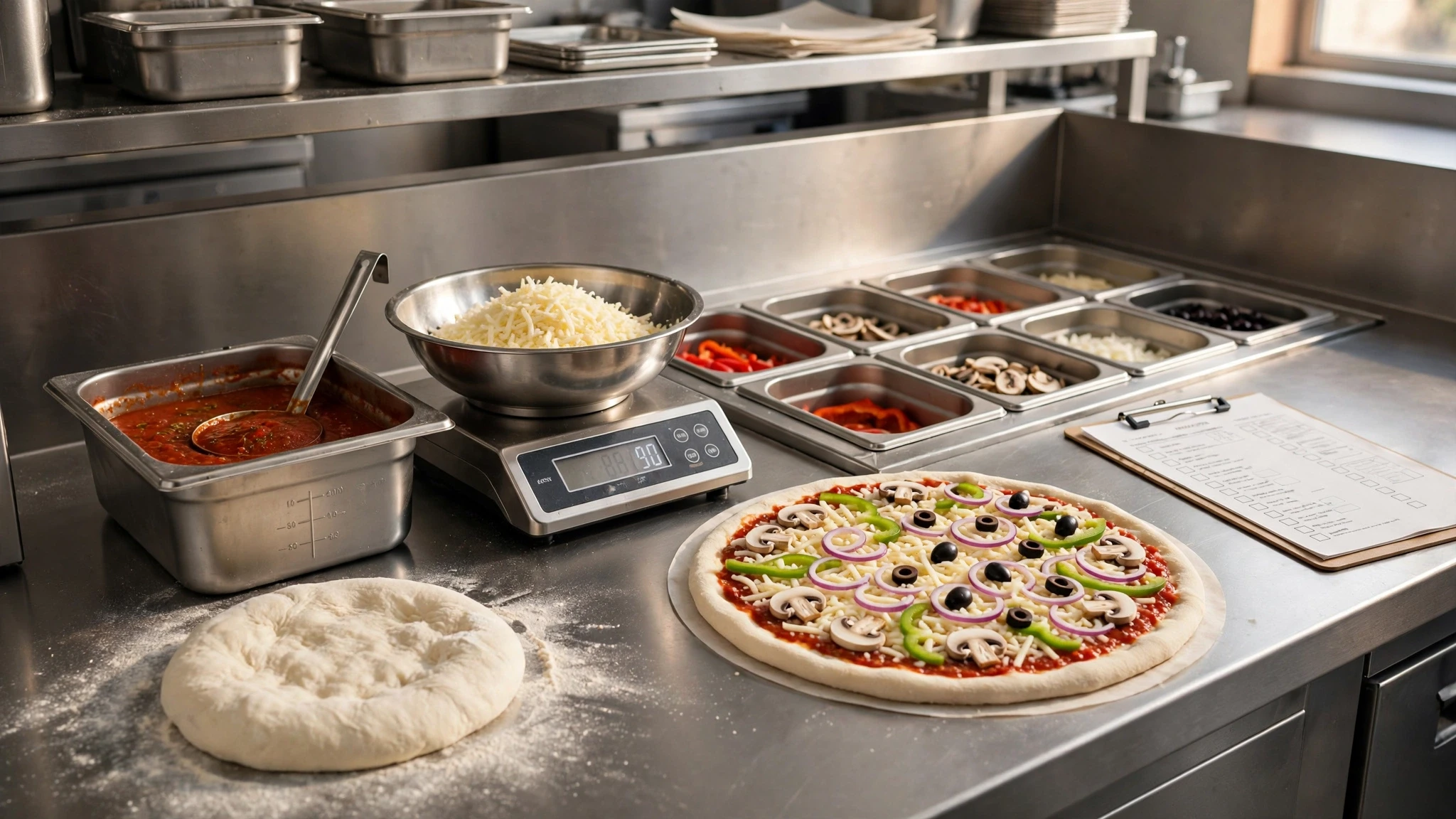
Pizza is a product where a few extra handfuls can erase consistency quickly.
One employee uses a heavier cheese cup, another spreads sauce to the edge, premium toppings are pinched by eye, and loaded pizzas are built differently depending on who is on the station. The food-cost variance may look small per pie and become large across thousands of orders.
A pizza topping standard defines the quantity and build method for each size and style so recipe cost, bake performance and guest experience describe the same product.
Create a build standard by pizza size
Do not use one topping quantity for every diameter. Define sauce, cheese and key toppings for each approved size/style.
| Component | Small | Medium | Large |
| Sauce | restaurant standard | restaurant standard | restaurant standard |
| Cheese | restaurant standard | restaurant standard | restaurant standard |
| Pepperoni/pieces | specified count/weight | specified count/weight | specified count/weight |
| Vegetable topping | specified weight/scoop | specified weight/scoop | specified weight/scoop |
The table intentionally omits generic amounts. The restaurant should test its dough, diameter, crust style and desired coverage.
Use weight or controlled tools
Cheese and high-cost toppings are often easiest to standardize by weight or by a verified cup/scoop.
If the station uses cups, periodically weigh the filled cup as employees actually use it. A cup that is heaped on one shift and level on another is not a standard.
Standardize sauce application
Define sauce quantity and application method: tool, starting point, coverage area and crust border appropriate to the concept.
Sauce affects not only cost but moisture, bake, slice structure and guest perception.
Standardize cheese distribution
A correct cheese weight can still bake unevenly if distribution is inconsistent.
Training should cover both quantity and spread: edge coverage, center loading and treatment of toppings that sit above or below cheese according to the recipe.
Use piece count where it improves consistency
Pepperoni, meatballs, shrimp or other countable premium toppings can sometimes be standardized by pieces when piece size is controlled.
If piece size varies materially, weight may be a better control.
Define topping zones
Half-and-half pizzas, specialty patterns and edge toppings need clear zones. Staff should understand how a half portion differs from simply using half the full topping weight when overlap or distribution changes.
Create a build sequence
1. Dough/base prepared to approved size.
2. Sauce applied at standard quantity/coverage.
3. Cheese portion applied according to recipe.
4. Primary toppings portioned and distributed.
5. Secondary/garnish components added in the approved sequence.
6. Visual check before bake.
7. Post-bake finish added only where specified.
Connect topping load to bake performance
Adding more toppings can slow bake, increase moisture or reduce crust quality. The standard should therefore be tested as a complete product, not just a cost target.
If a custom build exceeds the normal topping load, the restaurant needs a deliberate rule rather than relying on the oven operator to improvise.
Control extra toppings and modifiers
Extra cheese and premium add-ons should have defined additional quantity and price. ‘Extra’ is not unlimited product.
Restaurant Modifier Profitability: Price Add-Ons and Extras.
Control no-charge substitutions
Swapping one topping for another can change cost. Define which substitutions are equal, which carry an upcharge and which are not allowed because they change the recipe or bake behavior.
The policy should match actual POS modifier logic.
Cost the whole build
Pizza cost should include dough, sauce, cheese, standard toppings and any normal finishing ingredients.
When a topping standard changes, update recipe cost and modifier economics.
Use station reference cards
A concise build card can show pizza photo/diagram, size, sauce tool/quantity, cheese quantity, topping count/weight and sequence.
Do not overload the station with a long recipe manual when a clear controlled card can guide the repetitive build.
Verify scale/tool accessibility
A portion standard fails if the scale is across the kitchen or the correct scoop is constantly missing.
Place tools where the employee can follow the standard without slowing the line unnecessarily.
Run portion audits
During a calm period, ask several trained employees to build the same pizza without correction. Weigh or count the major components.
The variation reveals whether the standard is actually usable.
Separate recipe variance from waste
Toppings dropped on the floor, expired prep or over-prepped product are waste. Toppings placed on the pizza above standard are portion variance.
Track the correct cause so the fix targets either waste control or build discipline.
Example: cheese variance drives cost
A large pizza standard calls for a controlled cheese portion. Spot checks show actual builds vary by 15–20% between employees.
Supplier price has not changed, but cheese usage per pizza has. Management trains the fill/spread method and moves the scale to the station.
Example: premium topping modifier is underpriced
A premium topping is added using the same generous handful as a lower-cost vegetable. The menu charges one generic topping price.
After standardizing quantity and calculating incremental cost, management can decide whether modifier pricing needs tiers or whether portion needs adjustment.
Use sales mix to forecast topping prep
Once standard topping quantities are reliable, the kitchen can convert expected pizza mix into prep demand. If 70 large pepperoni pizzas are forecast and the standard uses a known quantity, required prep becomes calculable.
Manager weekly check
- Scale/scoop/tool available and calibrated/verified as appropriate.
- Build cards match current recipe version.
- Spot-check cheese and high-cost topping portions.
- Modifier quantities match POS pricing logic.
- Prep usage roughly aligns with pizza sales mix.
- Repeated remakes or bake issues linked to topping load.
- New employees trained on both quantity and distribution.
Common topping-standard mistakes
Training by ‘handful’
Hand size and habit create uncontrolled portions.
Using weight without distribution training
Cost is right while bake/product quality varies.
No standard for extra toppings
Modifiers consume unpredictable product.
Ignoring half-and-half logic
Employees overbuild split pizzas.
Not updating recipe cost
The costing system describes an old build.
Frequently asked questions
Should pizza toppings be weighed or counted?
Use the method that reliably controls the specific topping. Weight works well for variable pieces; count works when piece size is consistent.
What is the correct cheese amount for a large pizza?
Test the restaurant’s diameter, crust, cheese and desired product. There is no universal amount that fits every style.
Should extra cheese be double the standard?
Not automatically. Define a tested incremental quantity and price that works for the product.
How often should portions be audited?
Use a regular manager cadence and increase checks after training changes, new products, cost spikes or unusual usage variance.
Next action
Choose the highest-volume pizza size. Weigh sauce, cheese and the top three paid toppings on ten normal builds. Compare the spread with the approved recipe. Fix the biggest uncontrolled component first.
Related guides: