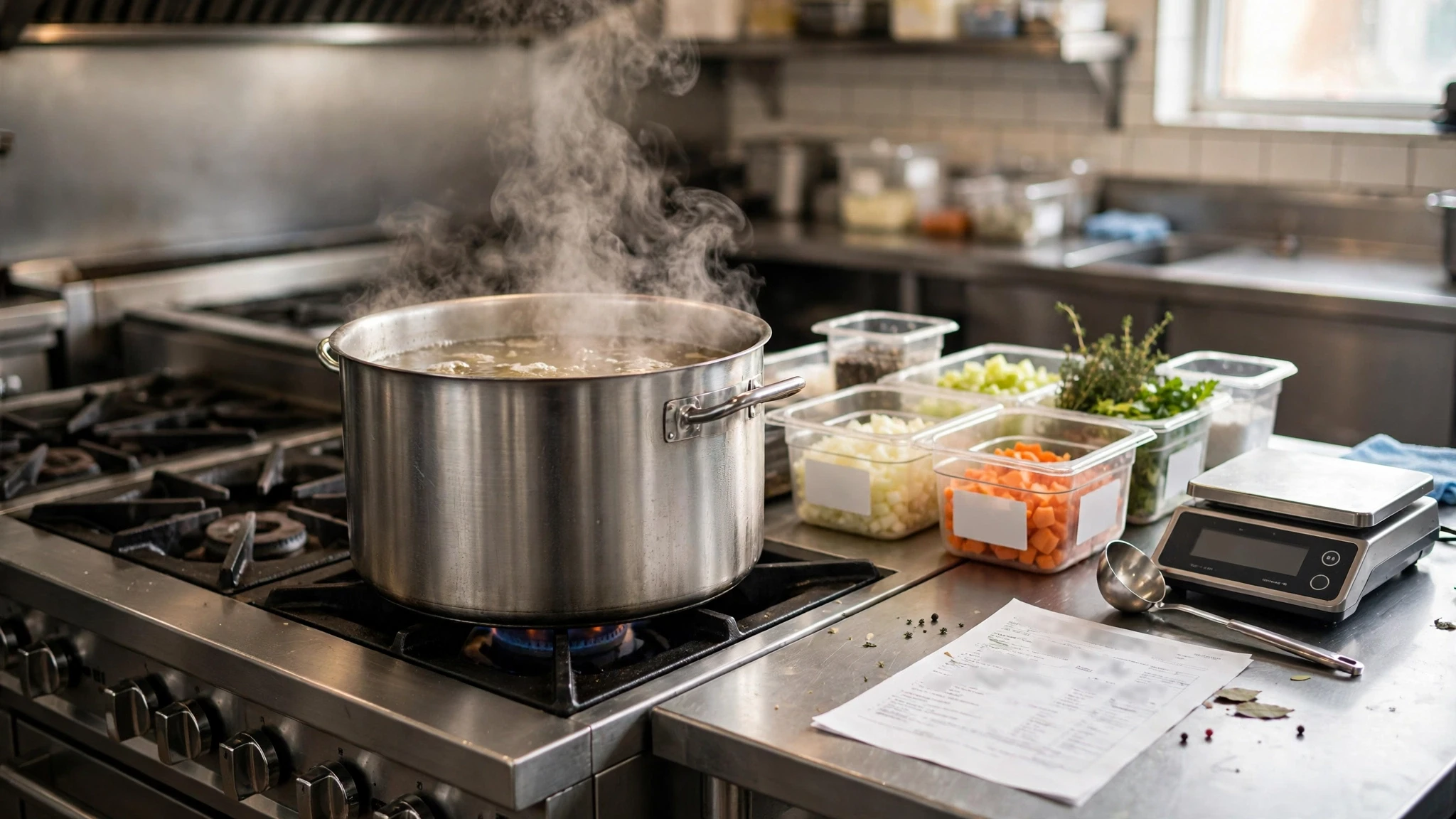
Soup looks simple to produce in bulk, which is exactly why it often escapes precise production control.
A kitchen makes “one pot,” but the pot is not always filled to the same level. One cook reduces longer than another. Ladle size changes. Garnish and add-ins are not included in the yield. The forecast says 70 portions, but the team makes enough for 110 because running out feels worse than carrying leftovers.
Soup batch planning turns the product into a controlled production unit: recipe batch, tested finished yield, standard portion, forecast portions, planned batches and actual result.
Start with one standardized recipe
The recipe should define ingredients, quantities, method, target finished yield, issue/portion unit and version.
If the recipe is written only as “large pot” or “one hotel pan,” the operation cannot calculate reliable portion cost or production demand.
Use finished yield, not raw input
Soup volume can change through evaporation, ingredient absorption, blending, straining and final adjustment. Measure the finished usable batch after the approved production process.
If a batch begins with 22 liters of combined ingredients and ends with 18.5 liters of finished soup, the production yield is 18.5 liters for planning purposes.
Calculate portions per batch
Portions per batch = finished usable yield ÷ standard portion.
Illustrative example: 18 liters ÷ 0.30 liters per portion = 60 portions.
Keep the example clearly separate from the restaurant’s actual recipe. Portion size and yield should come from the approved standard.
Verify the serving tool
If the recipe calls for 300 ml but the normal ladle delivers 350 ml, theoretical batch yield will not match service reality.
Measure the actual ladle or portion process under normal service conditions and train to the standard.
Forecast portions before deciding batch count
Use expected soup demand, not total restaurant covers. Soup attachment can differ by daypart, weather, season, menu position and whether soup is included in a combo.
Build the forecast from the restaurant’s own history: soup portions sold by day, service period and product.
Separate base demand from event demand
A catering order, group reservation or promotion can add demand that normal history will not predict. Add those committed portions explicitly rather than hoping the historical average absorbs them.
Choose a practical batch size
The largest possible stockpot is not always the best production batch.
Batch size should fit equipment capacity, safe/approved process, labor, demand pattern, storage/holding capacity, quality and the likelihood that another fresh batch can be produced later.
The restaurant may use a full batch, half batch or another tested size if each version has a controlled recipe and yield.
Do not scale by eye
If the kitchen needs 1.5 batches, scale the standardized quantities deliberately. Do not add “about half more” of each ingredient without accounting for spices, thickening, liquid and finishing ingredients.
For the full scaling and staging process, see Batch Recipe Production: How to Scale, Stage and Control Large-Batch Prep.
Build a production calculation
| Input | Example |
|---|---|
| Forecast soup portions | 92 |
| Committed catering/group portions | 18 |
| Planned total demand | 110 |
| Standard portions per batch | 60 |
| Batches mathematically required | 1.83 |
| Production decision | 2 tested batches, subject to approved holding/carryover plan |
The example shows the calculation structure. The production decision still depends on whether the second batch can be staged later and how the restaurant handles remaining product under its approved procedures.
Use a first-batch / second-batch strategy when appropriate
High-variability operations do not always need to produce the entire forecast at opening. If process time and food-safety controls allow, management can schedule a first batch and define a decision point for the next batch.
The decision point should be based on remaining portions, sales pace and time required to complete the next approved batch—not manager intuition alone.
Set a re-batch trigger
Example structure: when usable portions on hand fall to the number expected to sell during one production lead time plus a small internal operating allowance, start the next batch.
Do not copy a fixed number from another restaurant. Calculate it from this recipe’s lead time and actual demand pattern.
Track actual yield every production run
- Recipe/version.
- Planned batch count.
- Target finished yield.
- Actual finished yield.
- Standard portion.
- Expected portions.
- Actual portions sold or issued.
- Approved carryover or remaining quantity.
- Waste/variance note where applicable.
Investigate yield variance
If the same recipe repeatedly produces fewer portions than standard, possible causes include excess reduction, measurement error, ingredient variation, unrecorded tasting/usage, inconsistent finishing liquid or over-portioning.
If the batch repeatedly produces more, the standard yield may be understated or service portions may be smaller than intended.
Separate recipe yield variance from demand forecast error
Running out of soup can happen because the batch yielded too little or because demand exceeded forecast. Those are different problems.
Record both planned demand and actual yield so management knows whether to fix the recipe process or the forecast.
Cost the batch from current ingredient data
Batch cost should use current controlled ingredient costs and the approved recipe. Cost per portion = batch ingredient cost ÷ usable standard portions.
If yield drops, cost per usable portion rises even when supplier prices are unchanged.
For the full costing method, see Restaurant Recipe Costing: How to Calculate the True Cost of Every Dish.
Control high-cost add-ins
Soup can contain proteins, cream, cheese, seafood, garnish or finishing oil that materially affect cost. If these are portioned at service, include the service portion in the full item cost rather than assuming the pot cost includes everything.
Treat garnish as part of the standard
A garnish that varies by cook can create both cost and guest inconsistency. Define the approved garnish, tool and quantity where meaningful.
Plan container and serving capacity
Large-batch soup can bottleneck on stockpots, holding equipment, ladles, portion cups or takeout containers. Confirm the full production system before scheduling several overlapping batches.
Keep food-safety control separate
The production sheet does not replace the restaurant’s approved cooking, cooling, reheating, holding, labeling or storage procedures.
Do not invent shelf life or temperature limits from a cost-planning article. Use the applicable approved food-safety process.
Use daily demand history
Track soup portions by product and daypart. Compare forecast to actual demand and note unusual drivers: promotion, weather event, school holiday, group booking or menu change.
Over time, the restaurant can reduce the habit of making the same pot size every day.
Example: planned demand is right, yield is wrong
A manager forecasts 120 portions and plans two batches expected to yield 60 each. Actual batches yield only 54 each, leaving the kitchen 12 portions short even though the demand forecast was accurate.
The investigation should focus first on production yield and portion execution—not on adding a larger forecasting buffer.
Example: yield is right, demand is wrong
The same two batches correctly yield 120 portions, but 145 are ordered because a rainy day changes soup demand. That is a forecast issue. The response may be a faster re-batch trigger or weather-sensitive planning, not a recipe change.
Manager production review
1. Confirm current recipe/version.
2. Review expected portions by daypart and committed orders.
3. Choose the tested batch size.
4. Calculate planned batches.
5. Confirm equipment and ingredient availability.
6. Record target and actual finished yield.
7. Compare theoretical and actual portions.
8. Record remaining product/waste under the approved process.
9. Update the next production forecast using what was learned.
Build daypart pars instead of one daily par
Lunch and dinner may have different soup attachment rates. A single daily production target can cause the kitchen to overproduce before lunch or discover too late that dinner needs a second batch.
Where data support it, forecast opening quantity, expected lunch use, afternoon remaining quantity and dinner requirement separately. This creates a practical re-batch decision rather than one morning guess for the entire day.
Track solids-to-liquid consistency
For soups with significant solids—beans, meat, noodles, vegetables or dumplings—the usable guest portion is more than total liquid volume. If solids settle or cooks ladle inconsistently, early portions can contain more solids and later portions become mostly broth.
Standardize the service method, including stirring/mixing where appropriate under the recipe, so portion composition stays reasonably consistent across the batch.
Control finishing additions separately
Cream, herbs, cheese, acid, cooked noodles or other finishing ingredients may be added near service rather than during the base cook. Define whether those ingredients belong in the main batch yield or are issued per portion.
That decision should match both costing and production. If noodles are portioned separately, they should not disappear inside an assumed soup-liter cost.
Use a batch-size conversion sheet
If the restaurant routinely makes full and half batches, maintain an approved quantity column for each size rather than asking cooks to divide every ingredient mentally. For quarter or other sizes, test the recipe before making it a normal production option.
Some ingredients do not scale perfectly by intuition because evaporation, pot geometry and finishing adjustments can change. The tested yield for each routine batch size is more reliable than a mathematical assumption.
Plan prep components before the soup start time
The batch lead time should include prep that happens before the pot is assembled: stock thawing under approved procedures, vegetable prep, cooked proteins, soaked beans, measured spices or sub-recipes.
A “45-minute soup” can become a two-hour production task if those components are not ready. Record the real lead time when setting the re-batch trigger.
Measure forecast error by product
Do not average all soups together if the menu rotates products with very different demand. A tomato soup may sell steadily while a premium seafood soup is volatile. Track forecast-versus-actual by recipe/version where the volume justifies it.
When a product rotates seasonally, compare it with similar weeks or service conditions rather than a year-round average that includes months when it was not offered.
Control takeout and catering portions
Takeout cups, catering containers or combo portions may differ from dine-in bowls. Convert each channel into standard-equivalent portions for production planning or maintain separate portion sizes in the forecast.
If 16-ounce takeout and 10-ounce dine-in portions are mixed in one count, the kitchen can appear to have a yield problem when the real issue is channel mix.
Create a soup production variance table
- Forecast standard portions.
- Actual standard-equivalent portions sold/issued.
- Target batch yield.
- Actual finished yield.
- Opening or carried quantity where approved.
- Additional batch quantity.
- End remaining quantity and documented waste.
- Primary variance reason: forecast, yield, portion, event demand or recording error.
A short variance table gives the manager enough information to decide whether the next change belongs in the recipe, forecast, portion tool or production schedule.
Common soup-batch mistakes
Planning in pots instead of liters/portions
The same pot can contain different usable yields.
Using raw liquid volume as finished yield
Reduction and ingredient behavior are ignored.
No measured ladle standard
Service consumes the batch faster than the recipe predicts.
Producing the full peak forecast too early
Overproduction risk rises when demand is uncertain and a later batch is possible.
Mixing forecast failure with recipe-yield failure
Managers change the wrong control.
Frequently asked questions
How many portions should one soup batch make?
Whatever the restaurant’s tested finished yield and standard portion produce. Measure the actual recipe rather than using a generic pot-size estimate.
Should soup be made in one large batch or several smaller batches?
Choose based on demand variability, equipment, labor, quality and the restaurant’s approved production/holding process.
How should soup cost per portion be calculated?
Use current batch ingredient cost divided by the number of usable standard portions, then add any service garnish or components not included in the batch.
Can leftover soup be carried to the next service?
Only under the restaurant’s approved food-safety, quality and labeling procedures. This article does not set a universal carryover rule.
Next action
Take one high-volume soup and measure the next three finished batches. Record total usable liters and actual ladle portion. If the calculated portions differ materially from what the kitchen currently assumes, fix the recipe yield before changing pars or forecasts.
Related guides: