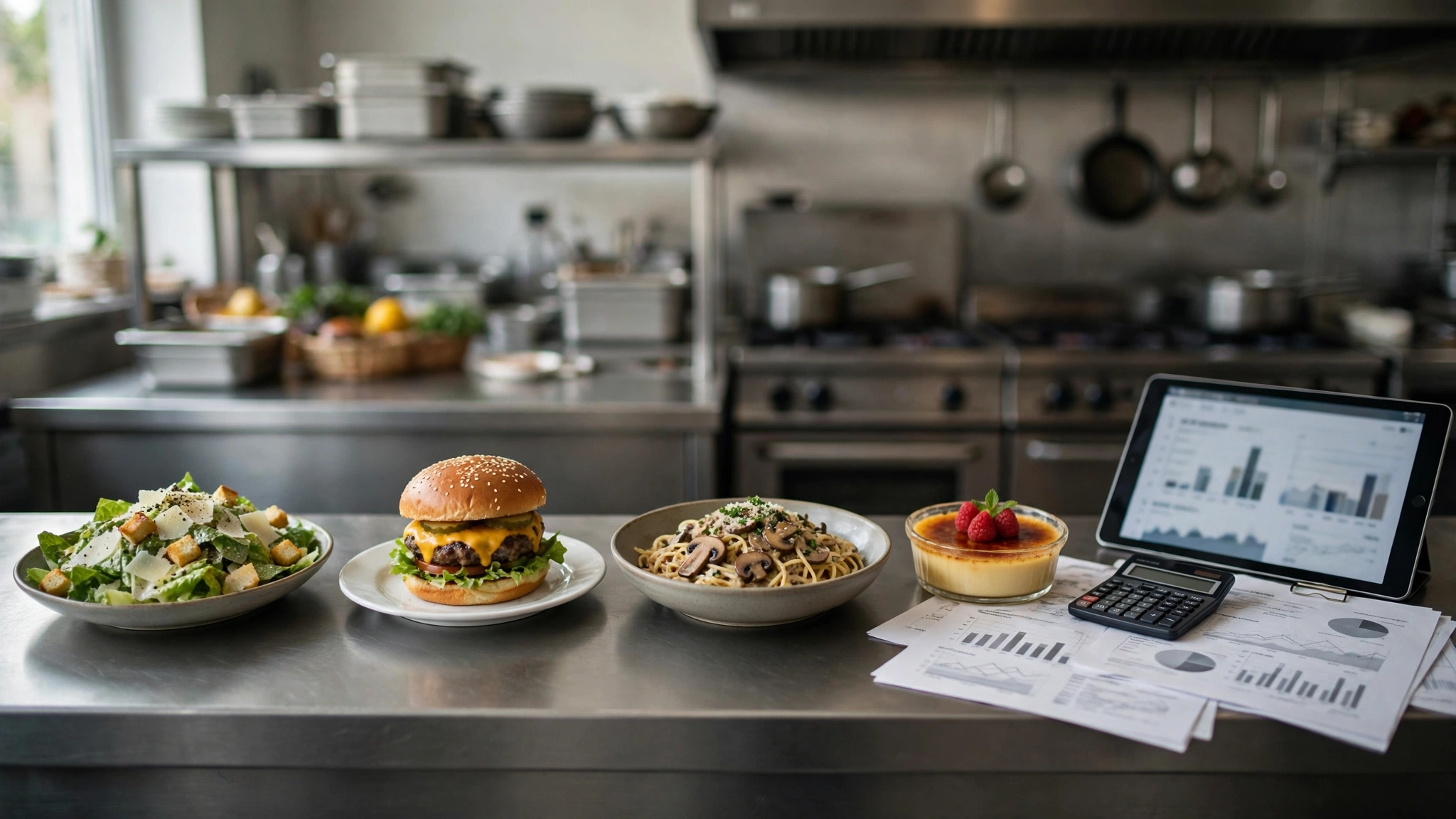
A bundle can increase sales and still reduce profit.
A meal deal may look attractive because average ticket rises, but the restaurant may be giving away a side and drink that many guests would have bought anyway. A family bundle may drive volume but add packaging, labor and discount cost. A lunch combo may improve speed while shifting customers away from a higher-contribution order.
Bundle profitability therefore needs more than one question:
Did the bundle sell?
The stronger question is:
Did the bundle improve contribution after considering what the guest would likely have bought without it?
Define the bundle economics before launch
For every proposed bundle, record:
• included items,
• normal standalone selling prices,
• bundle selling price,
• recipe/direct cost of each item,
• packaging cost where relevant,
• expected volume,
• expected substitution rules,
• target purpose.
The purpose might be:
• increase average check,
• move a high-contribution add-on,
• create a value price point,
• simplify ordering,
• improve lunch speed,
• drive family/off-premise demand,
• introduce a new item.
A bundle should have a commercial reason beyond “competitors have one.”
Calculate standalone contribution first
Suppose the normal order is:
| Item | Price | Direct cost | Contribution |
|---|---|---|---|
| Burger | $12.00 | $4.20 | $7.80 |
| Fries | $4.00 | $1.00 | $3.00 |
| Drink | $3.00 | $0.55 | $2.45 |
If purchased separately:
Revenue = $19.00
Direct cost = $5.75
Contribution = $13.25
The example is illustrative.
For menu-item contribution basics: Restaurant Menu Item Profitability: How to Measure Contribution Margin
Calculate bundle contribution
Assume the bundle sells for $16.50 with the same direct cost of $5.75.
Bundle contribution = $16.50 – $5.75 = $10.75
The guest receives a $2.50 discount versus standalone price.
The restaurant gives up $2.50 of contribution compared with a guest who would have bought all three items anyway.
That does not automatically make the bundle bad. The bundle may cause more guests to add fries/drink or choose the restaurant.
The key is incremental behavior.
Measure attachment lift
If most burger buyers currently purchase only the burger, the combo may add contribution even at a discount.
Suppose before launch:
• 100 burger orders,
• 35 include fries,
• 28 include a drink.
After launch:
• 100 burger orders,
• 62 are sold as full combos.
The bundle increased attachment.
Management should compare total contribution per 100 burger transactions before and after, not just the combo margin.
Watch cannibalization
Cannibalization occurs when the bundle replaces a more profitable purchase that would have happened anyway.
Examples:
• regular customers who always bought burger + fries + drink now receive a discount,
• customers move from premium entree to low-price bundle,
• a high-margin side is replaced by a lower-margin included item,
• full-price family orders shift into discounted family packs.
A bundle can be popular and still be economically weak because of cannibalization.
Build three customer scenarios
Before launch, model at least three behaviors.
Scenario A: incremental attachment
The guest would have bought only the main item. The bundle adds side and drink.
Scenario B: full cannibalization
The guest would have purchased all bundle items separately anyway.
Scenario C: trade-down
The guest would have purchased a higher-priced/higher-contribution option but chooses the bundle instead.
Estimate the likely mix rather than assuming every bundle sale is incremental.
Example: contribution by scenario
Using the illustrative burger bundle:
• Main-item-only contribution: $7.80
• Full standalone contribution: $13.25
• Bundle contribution: $10.75
If the bundle converts a main-item-only guest, contribution rises:
$10.75 – $7.80 = +$2.95
If the bundle discounts a guest who would buy all items separately:
$10.75 – $13.25 = -$2.50
The same bundle creates opposite outcomes depending on behavior.
Do not judge bundles by food-cost percentage alone
A bundle can have a higher food-cost percentage but produce more contribution dollars.
It can also have an attractive food-cost percentage and still cannibalize a better transaction.
Use:
• contribution dollars,
• contribution per transaction,
• total transaction volume,
• attachment rate,
• average check,
• cannibalization estimate.
For broader promotion review: Restaurant Promotion Profitability: Measure Discounts, Traffic and Contribution Before Repeating an Offer
Price the discount intentionally
The discount should be visible enough to create value but not automatically equal the maximum discount the restaurant can afford.
A pricing workflow:
- Calculate standalone value.
- Calculate bundle direct cost.
- Set several candidate prices.
- Calculate contribution at each price.
- Estimate customer scenarios.
- Test demand and cannibalization.
Do not set the price only by copying a competitor’s bundle.
Model substitution rules
Bundles become expensive when guests can substitute freely without price logic.
Define:
• included side choices,
• included drink size,
• premium upgrade price,
• protein substitutions,
• extra sauces/add-ons,
• removal of included items,
• modifier restrictions where appropriate.
If a premium side adds $1.20 of direct cost but the upgrade is only $0.50, the bundle economics change quickly.
For modifier economics: Restaurant Modifier Profitability: Price Add-Ons, Extras and Substitutions
Include packaging in off-premise bundles
A family bundle may require:
• larger containers,
• drink carriers,
• bags,
• sauces/cups,
• labels,
• tamper seals.
If the bundle is mainly delivery/takeout, packaging should be treated as part of the direct economics.
Include delivery-channel fees separately
Do not assume a bundle that works for dine-in works on third-party delivery.
Marketplace commission, promotional fees or channel discounts can change contribution materially.
A restaurant may need different bundle pricing by channel if permitted by its commercial agreements and market strategy.
Use bundles to simplify operations only when they truly simplify
A fixed combo can reduce order complexity.
But a highly customizable combo can do the opposite.
Track:
• order-entry time,
• modifier count,
• kitchen ticket complexity,
• packing steps,
• remake rate.
Operational complexity belongs in the decision even if the food economics look acceptable.
Watch capacity at peak periods
A bundle can shift demand toward a station that is already the bottleneck.
Example:
A combo includes fries, and fryer capacity is already tight at dinner.
If combo adoption rises sharply, ticket time may increase even though sales improve.
Menu engineering should consider throughput, not only margin.
Test bundles with a defined period
A controlled test is more useful than a permanent launch with no baseline.
Before test:
• choose start/end dates,
• define locations/dayparts,
• record baseline attachment and contribution,
• set target metrics,
• keep other major changes limited where possible.
During test, review weekly.
Build a bundle scorecard
Track:
| Metric | Baseline | Test | Direction |
|---|---|---|---|
| Main-item transactions | 1,000 | 1,080 | Up |
| Side attachment | 38% | 61% | Up |
| Drink attachment | 31% | 57% | Up |
| Contribution/transaction | $8.60 | $9.05 | Up |
| Avg ticket | $14.20 | $15.10 | Up |
The figures are illustrative.
The scorecard should include contribution, not only sales.
Compare bundle buyers with non-bundle buyers
If the POS can identify bundle transactions, compare:
• average check,
• contribution estimate,
• modifier spend,
• dessert/appetizer attachment,
• channel,
• daypart,
• repeat purchase if loyalty data exists.
A lunch bundle may work very differently from the same offer at dinner.
Family bundles need quantity logic
Family offers often mix several products and portions.
Check:
• realistic number of servings,
• high-cost proteins,
• included sides,
• sauce/condiment cost,
• packaging,
• portion consistency,
• whether guests frequently request substitutions.
Do not design a bundle using vague labels like “feeds four” without standard production quantities.
Limited bundles can protect margin
Sometimes the best design is narrow:
• selected main items only,
• one standard side,
• one drink size,
• premium upgrades priced separately.
This can make the offer easier to execute and cost.
Compare bundle contribution with target menu mix
A bundle should support the menu strategy.
If management wants to shift sales toward a high-contribution main item, a bundle can help.
If the bundle increases the share of an already low-contribution item, it may move menu mix in the wrong direction.
For menu-mix control: High-Profit Menu Mix: How to Shift Sales Toward Better Contribution
Example: bundle test decision
Assume a four-week test shows:
• combo adoption: 46% of eligible orders,
• main-item transactions: +8%,
• fries attachment: +19 percentage points,
• drink attachment: +23 points,
• contribution per eligible transaction: +$0.38,
• peak ticket time: +1.5 minutes.
The figures are illustrative.
The restaurant should not automatically keep or kill the bundle.
Management should ask whether the extra contribution justifies the capacity impact and whether the design can be simplified.
Calculate the volume lift needed to offset a discount
A bundle discount can be tested against the extra transactions or attachment it must create.
Suppose the restaurant gives up $2.50 of contribution on each fully cannibalized bundle sale. If management expects 200 such sales in a week, contribution given up is:
200 x $2.50 = $500
If each incremental bundle from a main-item-only buyer adds $2.95 of contribution, the restaurant would need roughly:
$500 / $2.95 = 170 incremental bundle conversions
The numbers are illustrative.
This does not predict demand. It tells management what behavior the offer must generate to pay for the discount.
Measure basket effects beyond the bundle
Bundles can change purchases outside the bundle.
Track whether bundle buyers are more or less likely to add:
• dessert,
• appetizer,
• premium beverage,
• extra protein,
• paid modifier.
A low-price combo that suppresses profitable add-ons may be weaker than its direct contribution suggests. A bundle that creates a larger total basket may be stronger.
Set launch gates before the test starts
Define in advance what would cause management to:
• keep the bundle,
• reprice it,
• simplify it,
• limit it to a daypart/channel,
• stop it.
Example gates might use the restaurant’s own minimum acceptable contribution per eligible transaction, maximum ticket-time deterioration and minimum attachment lift.
Do not invent the gates after seeing the result. Predefined decision rules reduce the temptation to keep a popular offer that does not meet the original commercial purpose.
Compare bundle economics by daypart
The same combo can perform differently at lunch, dinner and late night. Measure contribution, attachment and speed by daypart before applying one conclusion to the whole menu. A lunch bundle may create useful throughput and incremental beverage sales, while the same discount at dinner may mostly cannibalize guests who would have bought full-price items. If behavior differs materially, limit the offer to the daypart where it actually improves the transaction economics.
Common bundle mistakes
Using standalone discount as the only metric
Behavior matters more than the visible discount.
Ignoring cannibalization
Existing full-price buyers receive unnecessary discount.
Allowing unlimited substitutions
Direct cost drifts upward.
Ignoring channel fees
Delivery contribution is overstated.
Ignoring throughput
The offer overloads a bottleneck station.
No baseline
The restaurant cannot tell what changed.
Keeping a popular bundle that lowers contribution
Volume is mistaken for profitability.
Bundle profitability checklist
- Standalone prices are known.
- Direct costs are current.
- Bundle contribution is calculated.
- Incremental-attachment scenario is modeled.
- Cannibalization scenario is modeled.
- Trade-down risk is considered.
- Substitution rules are priced.
- Packaging and channel costs are included where relevant.
- Capacity impact is reviewed.
- Test period and baseline are defined.
- Contribution per transaction is tracked.
- Keep, change or end decision is scheduled.
Frequently asked questions
How much discount should a bundle offer?
There is no universal percentage. Test prices based on contribution, customer value, competitive context and expected behavior.
Are bundles always bad for margin?
No. A bundle can increase total contribution if it increases attachment, transactions or mix enough to offset the discount.
Should delivery bundles cost more?
They may require different economics because of packaging and platform fees. Any channel pricing should fit the restaurant’s commercial agreements and strategy.
What is the most important bundle metric?
Contribution per eligible transaction is more informative than bundle sales alone because it captures the effect on the transaction economics.
Next action
Take one existing or proposed bundle and calculate three outcomes: the guest would have bought only the main item, the guest would have bought every item separately, and the guest trades down from a higher-contribution order. If the offer works only under the most optimistic scenario, it is not ready to launch.