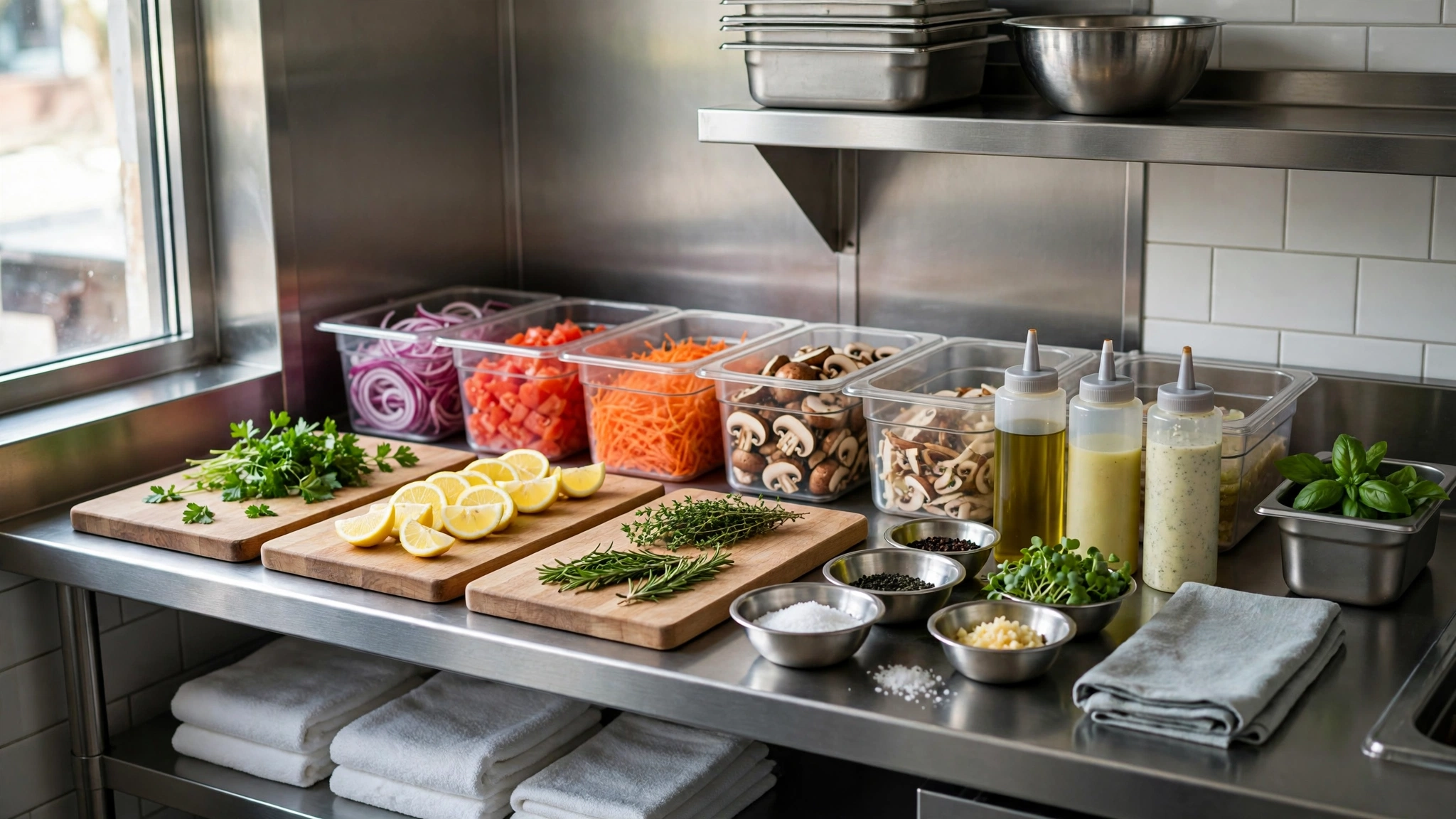
A prep list can tell the kitchen what must be made and still fail to answer the most important question:
Can the team actually complete that work before service with the labor, equipment and station capacity available?
That is the difference between prep planning and prep capacity planning.
A kitchen can have accurate production targets and still start service behind because three high-workload tasks need the same oven, two cooks need the same table, or the planned work requires 420 labor minutes when only 300 are available.
Capacity planning makes those constraints visible before the rush.
Start with the required production, not available staff
The first input is the work that must be completed.
Use the production plan, forecast, reservations, catering orders and required setup to define tasks such as:
- vegetable prep,
- protein trimming and portioning,
- sauce production,
- rice or starch batches,
- dough preparation,
- bakery production,
- cold-station setup,
- garnish and portion packs,
- backup batches,
- opening line setup.
For how to calculate prep quantities, use the existing prep-list guide:
This article begins after the quantity is known.
Convert the prep list into task minutes
A quantity does not show workload until the kitchen understands how long the task normally takes.
For each important task, record:
- quantity,
- normal batch size,
- active labor minutes,
- equipment time,
- station required,
- earliest start,
- required finish time.
Example:
| Task | Quantity | Labor minutes | Main constraint | Ready by |
|---|---|---|---|---|
| Portion chicken | 24 kg | 60 | Protein prep table | 3:00 PM |
| Make sauce | 12 L | 35 | Mixer | 3:30 PM |
| Cook rice | 6 pans | 30 active | Rice cooker | 5:00 PM |
| Cut vegetables | 18 kg | 70 | Cold prep table | 4:00 PM |
| Set line | 1 service | 45 | Line access | 5:15 PM |
The times are illustrative. A restaurant should build its own standards from repeated observation.
Separate active labor time from equipment time
A task can occupy equipment without occupying a cook for the entire cycle.
For example:
- loading a batch into an oven may take 8 active minutes,
- baking may take 30 minutes,
- unloading and checking may take another 5 minutes.
That is not 43 active labor minutes.
It is:
- 13 active labor minutes,
- 30 minutes of equipment occupancy.
This distinction matters because labor capacity and equipment capacity can be different bottlenecks.
Calculate available labor minutes
A simple capacity check is:
Available prep labor minutes = number of prep employees × usable prep minutes per employee
Suppose two employees each have 150 usable minutes before service:
2 × 150 = 300 available labor minutes
If the required prep work is 390 active labor minutes, the plan is overloaded by 90 minutes before anyone starts.
That does not automatically mean “add another employee.”
It means the manager needs to change the plan deliberately.
Do not treat every paid minute as productive prep capacity
An employee scheduled from 1:00 to 5:00 does not necessarily provide 240 minutes of prep.
That time may also include:
- receiving,
- cleaning,
- breaks,
- meetings,
- opening tasks,
- station setup,
- interruptions,
- training,
- helping another station.
Use realistic usable capacity.
Otherwise the plan will be mathematically complete and operationally impossible.
Identify the station bottleneck
Labor may be available while the workstation is not.
Common prep constraints include:
- one protein table,
- one mixer,
- one slicer,
- limited oven capacity,
- limited fryer capacity,
- one sink,
- limited cold-room work space,
- limited blast-chill or cooling capacity where applicable,
- limited storage containers.
If two tasks require the same station at the same time, the schedule must sequence them.
Capacity planning is partly a queue-management problem.
Map task dependencies
Some tasks cannot begin until another task finishes.
Examples:
- a sauce may need a cooked base before mixing,
- chicken cannot be portioned until receiving is completed,
- a dough may require proofing before shaping,
- a cooked component may need approved cooling before later use,
- a station cannot be set until cleaning is complete.
Build the dependency into the plan.
Do not schedule a downstream task at 3:00 if its input is not realistically available until 3:20.
Food preparation, cooling, holding and storage must follow the food-safety procedures and legal requirements applicable to the operation. Capacity planning must not shorten required safety steps.
Find the critical path
The critical path is the sequence of tasks that controls the earliest possible finish time.
In a small kitchen, it may be:
Receive chicken → portion chicken → marinate → stage line
Or:
Mix dough → rest/proof → divide → bake → cool → pack
Tasks outside that path may have flexibility. Critical-path tasks have less.
Managers should protect those tasks from avoidable interruptions.
Build around deadlines, not start times
Weak prep plans say:
Start sauce at 2:00.
A stronger plan says:
Sauce must be ready by 3:30, requires 35 active minutes and the mixer is also needed for dressing at 3:00.
The finish-time logic makes conflicts visible.
Work backward from service.
Use a capacity board
A simple board can show:
| Task | Owner | Start window | Constraint | Ready by | Status |
|---|---|---|---|---|---|
| Chicken portioning | Ali | 1:00-2:00 | Protein table | 2:15 | |
| Sauce batch | Maria | 2:00-2:40 | Mixer | 3:00 | |
| Vegetable prep | Ali | 2:15-3:25 | Cold table | 3:30 | |
| Rice batch 1 | Maria | 3:00 | Rice cooker | 3:50 | |
| Line setup | Both | 4:30-5:10 | Line access | 5:15 |
This is not meant to become a bureaucratic project plan.
It is a visual way to see ownership, timing and constraints.
Use batch size to manage the bottleneck
A large batch can reduce repeated setup but may consume equipment or station capacity for too long.
A small batch can increase flexibility but create more handling.
Choose batch size based on:
- demand,
- equipment capacity,
- quality,
- holding limits,
- labor,
- container capacity,
- service timing.
For large-batch controls:
Protect the pre-service window
The final hour before service is often overloaded because too many tasks are allowed to drift into it.
Classify prep tasks:
Must finish early
Long tasks, cooling-dependent tasks, major batch production.
Can finish near service
Fresh garnish, final assembly, selected short-life preparation where appropriate.
Should not still be happening at open
Major production tasks that block a station, create mess or require the same equipment needed for service.
The exact classification depends on the restaurant.
Build a response hierarchy for overload
When required work exceeds capacity, use a defined response instead of panic.
A practical order is:
1. verify the demand assumption,
2. verify the quantities and usable stock on hand,
3. remove duplicate or unnecessary work,
4. move eligible work earlier,
5. re-sequence tasks around equipment,
6. use trained cross-coverage,
7. split batches where operationally appropriate,
8. add planned labor if the demand justifies it,
9. adjust noncritical production or availability decisions if necessary.
The restaurant should never “solve” a capacity shortage by skipping food-safety controls or rushing unsafe handling.
Use skill capacity, not just headcount
Three employees are not three interchangeable units of capacity.
A task may require:
- knife skills,
- bakery skills,
- equipment authorization,
- recipe knowledge,
- allergen-control training,
- supervisory approval.
Capacity planning should show which tasks require which skills.
Cross-training is valuable because it increases usable capacity, not because it makes responsibility vague.
Example: the overloaded Friday prep window
Assume the kitchen has two prep cooks from 1:00 to 4:00.
After breaks and required non-prep tasks, the manager estimates 320 usable prep labor minutes.
The required tasks total:
| Task | Labor minutes |
|---|---|
| Chicken prep | 75 |
| Vegetable prep | 80 |
| Two sauces | 55 |
| Portion desserts | 45 |
| Catering garnish | 40 |
| Line setup | 55 |
| Total | 350 |
The plan is short by 30 labor minutes.
But the deeper review shows that the dessert portions can be completed by a trained closing team the night before under the restaurant’s approved process.
That moves 45 minutes out of the Friday window.
Now the plan has:
305 required minutes vs 320 usable minutes
The Friday prep window becomes feasible without adding a person.
The example is illustrative. The lesson is to change the work design before assuming labor is the only answer.
Watch equipment collisions
A prep plan can pass the labor test and still fail.
Suppose:
- sauce needs the mixer 2:00-2:30,
- dressing needs the mixer 2:10-2:25,
- dessert filling needs the mixer 2:20-2:40.
That is impossible with one mixer.
The capacity board should expose the collision before production starts.
The fix may be:
- change sequence,
- move one task earlier,
- change batch timing,
- use approved alternative equipment if suitable.
Connect prep capacity to the labor forecast
If the kitchen is repeatedly overloaded on the same day, the labor plan should learn from it.
Compare:
- forecast prep workload,
- planned prep hours,
- actual prep hours,
- service readiness,
- overtime or late clock-outs,
- work deferred into service.
Related guide:
The purpose is not to inflate labor. It is to place labor where the work actually exists.
Use actual completion time to improve the standards
Task-time standards should come from the restaurant’s own operation.
After service, record unusual differences.
Example:
Planned vegetable prep: 60 minutes
Actual: 92 minutes
Do not immediately change the standard to 92.
Ask why:
- larger volume?
- poor knife setup?
- new employee?
- product quality?
- station interruption?
- equipment problem?
Repeated evidence should change the standard. One abnormal day should not.
Include setup and cleanup in task time
Managers often time the “productive” middle and ignore:
- retrieving ingredients,
- setting equipment,
- sanitizing according to the operation’s procedure,
- labeling containers,
- putting product away,
- cleaning the station.
Those minutes are real.
A task standard that excludes them will consistently understate workload.
Create a pre-service capacity gate
Thirty to sixty minutes before service, the manager should know whether the plan is on track.
Review:
- critical tasks complete?
- line setup on schedule?
- any equipment bottleneck?
- backup quantity staged?
- any station missing a skilled person?
- any task likely to run into service?
If a critical task is late, make a decision.
Do not wait until the first ticket exposes it.
For station readiness:
Restaurant Kitchen Line Readiness
Track the reason prep ran late
Use a short reason list:
- forecast too low,
- quantity calculation wrong,
- staff absence,
- task took longer than standard,
- equipment conflict,
- equipment failure,
- receiving delay,
- rework,
- unplanned catering/order volume,
- poor sequence.
After several weeks, patterns appear.
That creates a better improvement plan than saying “prep needs to be faster.”
Keep prep capacity and service capacity separate
A kitchen may have enough people for service and not enough pre-service capacity.
Or the reverse.
Do not hide prep problems inside the overall labor percentage.
Measure the work by phase:
- preparation,
- service,
- closing.
That makes scheduling and process design more precise.
Common prep-capacity mistakes
Counting paid hours as usable prep hours
Interruptions and required non-prep work disappear from the plan.
Ignoring equipment occupancy
Three tasks are scheduled on one machine.
Leaving all fresh work until the final hour
The pre-service window becomes overloaded.
Adding labor before checking the sequence
The problem may be the workflow.
Using one task-time standard forever
Process, product and people change.
Solving overload by cutting required safety steps
Never use capacity pressure as a reason to bypass food-safety controls.
A weekly capacity review
Once a week, compare:
1. Which days started service late?
2. Which tasks missed their ready time?
3. Which station or equipment caused repeated waiting?
4. Where did actual task minutes exceed the standard?
5. Which work can be moved to a better time?
6. Does the labor plan match the prep workload?
7. What one process change should be tested next week?
This keeps prep planning tied to evidence.
Frequently asked questions
Is prep capacity planning only for large kitchens?
No. Small kitchens often benefit more because one table, one mixer or one skilled employee can become a major bottleneck.
How accurate do task times need to be?
Accurate enough to expose overload and repeated bottlenecks. Start with reasonable observed standards and improve them from actual results.
Should every prep task be timed?
No. Focus first on high-workload, high-risk or bottleneck tasks.
Is extra prep labor always the answer?
No. Quantity errors, poor sequence, duplicated work and equipment conflicts can create the same symptom.
Should prep be completed entirely before service?
Not necessarily. The correct split depends on product quality, demand, food-safety requirements and the restaurant’s production model.
Five-step implementation sequence
- Translate tomorrow’s prep list into task minutes and ready-by times.
- Compare required labor minutes with realistic usable prep capacity.
- Map equipment, station and skill constraints before assigning work.
- Move or resequence tasks that overload the final pre-service window.
- Review late tasks after service and update only standards supported by repeated evidence.
Prep-capacity manager checklist
- Critical tasks have ready-by times.
- Active labor time is separated from equipment occupancy.
- Shared equipment conflicts are visible before prep begins.
- Required skills are matched to the assigned employee.
- A pre-service capacity check happens before the rush.
Next action
Take tomorrow’s prep list and add only three columns: active labor minutes, main constraint and ready-by time. Total the labor minutes and compare them with realistic available prep capacity. That one exercise usually reveals where the plan is overloaded before the kitchen feels it.