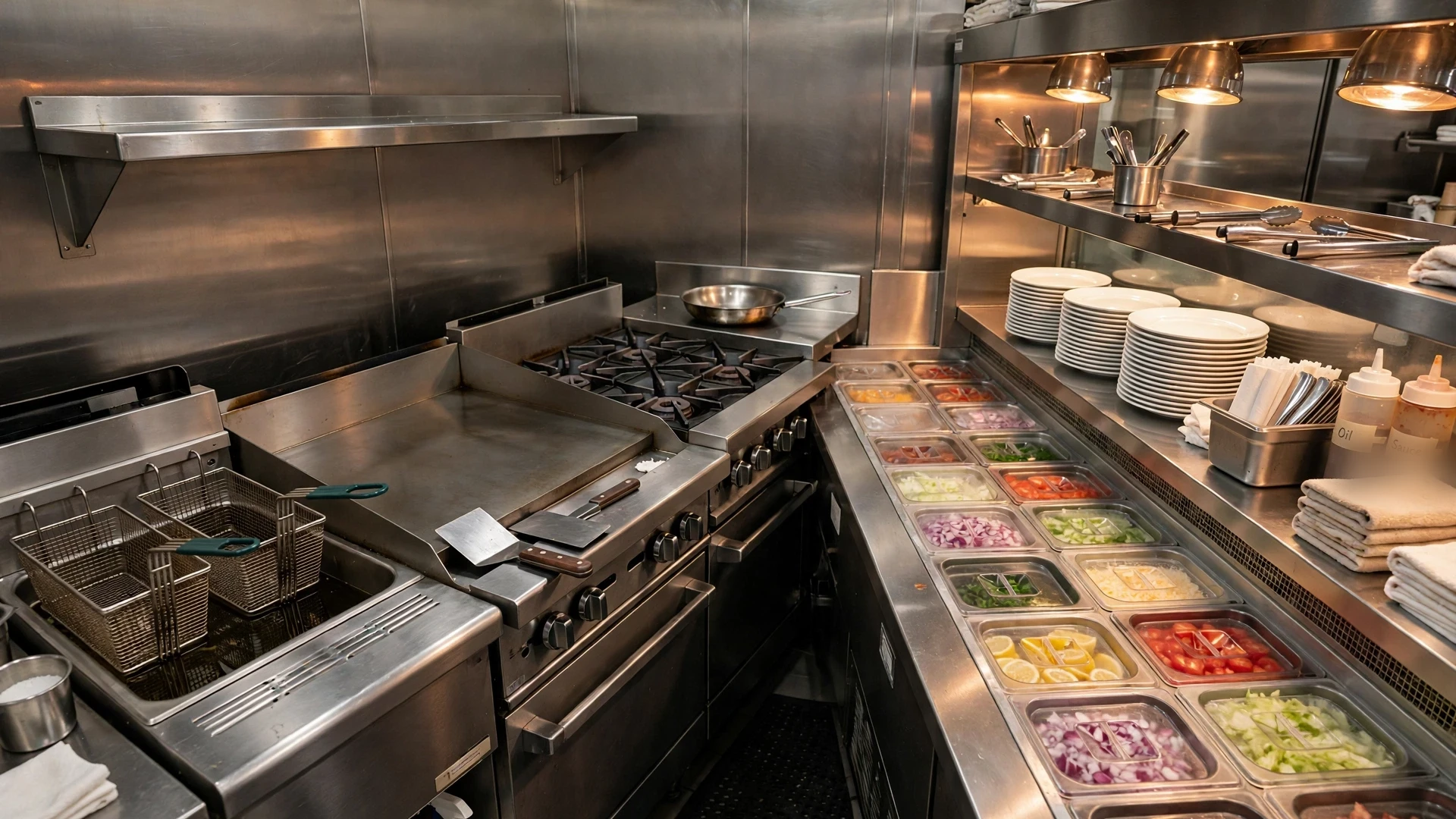
The pass/fail idea behind line readiness
Line readiness is not the same as “the kitchen is open.” A station is ready only when it can accept normal service demand without borrowing tools, ingredients, information or labor from another station. The pre-service check should therefore test production capability, not appearance. A clean line can still be unready if backups are missing, holding equipment is not at operating condition, recipe references are unclear, or one high-volume component is still cooling in the prep area.
Treat readiness as a release decision. Green means the station can start service. Amber means a known gap has a controlled workaround and an owner. Red means the gap can create unsafe food handling, predictable ticket delay, repeated remakes or uncontrolled substitutions. This simple language makes the pre-service conversation faster than a long checklist with no decision rule.
Start with the menu demand map
Before walking the line, identify the items most likely to load each station. A grill station serving three of the five top sellers deserves a different readiness test from a low-volume dessert station. Pull expected covers, reservations, daypart history and known promotions into one quick demand picture. The purpose is to ask whether the station is ready for the service that is actually coming, not an abstract average shift.
Map each high-volume item to its critical components: protein, sauce, garnish, side, holding pan, smallware and finishing step. If one component fails, note which menu items are affected and whether a safe approved substitute exists. This turns mise en place into an operational dependency map.
Station-by-station readiness route
Walk the line in production order rather than random physical order. Start where raw product enters the station, follow the cooking or assembly sequence, and finish at the pass. Check reach, labels, clean utensils, calibrated thermometers where required, backup pans, hot and cold holding, waste containers, printer or KDS visibility, and the physical space needed to work at peak volume.
Ask the station lead to produce the first likely ticket mentally: where does each component come from, which pan is used, what happens if two modified orders arrive together, and what is the backup when the first insert empties? The answers reveal hidden readiness gaps faster than asking “Are you ready?”
Par levels should reflect the first service wave
A station does not need the entire shift’s production on the line. It needs enough to handle the first demand wave plus a replenishment plan that protects quality. Oversized line pars increase holding time and waste; undersized pars create emergency prep during the rush. Set opening pars from recent item mix, portion size, expected covers and realistic replenishment time.
For each critical item, record opening par, backup location and refill trigger. A refill trigger can be a quantity, a time or a combination. The trigger is important because it converts replenishment from a cook’s memory into a visible control.
Equipment readiness is more than “powered on”
Verify that equipment has reached usable operating condition. A fryer that is heating, a cold rail that has not recovered after loading, or a salamander with uneven performance can all create predictable service delay. Check obvious alarms, unusual noise, drainage, pilot or ignition status where applicable, working lights and the condition of surfaces that contact food.
Do not turn the line check into unauthorized maintenance. Operators should know the difference between an operating check and technical service. If equipment shows signs of unsafe operation, gas, electrical, fire-suppression or refrigeration issues, escalate to qualified service according to site procedures.
The pass and handoff check
Many kitchens fail at the point where stations meet. Verify plateware, garnishes, heat lamps or holding position, ticket display, expo tools, allergy communication method, side-item coordination and the physical path for finished food. A ready grill station cannot protect ticket time if expo is missing plates or the side station has no backup.
Run one mock ticket containing a common modifier and one item from more than one station. The objective is not speed; it is to expose missing information, awkward handoffs and equipment conflicts before guests create the pressure.
Use a compact readiness scorecard
A useful sheet can list each station, critical items, opening par, equipment status, unresolved gap, owner and release status. Keep it short enough to complete during the real pre-service window. Attach detail only when there is an exception. The scorecard should answer one management question: which station could fail first and what has been done about it?
Do not score every tiny detail equally. A missing garnish container and a refrigeration alarm are not the same class of issue. Separate food-safety or equipment risks from service-readiness gaps and cosmetic issues.
| Status | What it means | Manager action | Release rule |
|---|---|---|---|
| Green | Critical product, equipment, smallwares and handoffs are ready for expected demand. | Release the station and record only unusual notes. | Open normally. |
| Amber | A known gap exists, but a safe and practical workaround has an owner and completion time. | Write the workaround, owner, refill or repair trigger, and recheck time. | Open only if the workaround protects safety, quality and service flow. |
| Red | The gap can create unsafe food handling, unavailable menu items, predictable ticket failure or uncontrolled substitution. | Correct the condition, control the affected item, or escalate the equipment/process issue. | Do not release the affected station or item until the release condition is met. |
This decision table keeps the readiness check operational. The manager is not trying to accumulate checkmarks; the manager is deciding whether each station can handle the next service wave, whether a temporary control is genuinely safe and workable, and what exact condition must be met before an unresolved gap can be closed.
Station release workflow
- Identify the station’s top-selling and highest-risk items for the coming service.
- Verify critical components, opening pars, backup location, smallwares and operating equipment.
- Test the handoff to expo or the next station with one representative ticket path.
- Classify each material exception as green, amber or red using the release table.
- For every amber condition, record one owner, the temporary control, the completion time and the exact recheck point.
- For every red condition, hold the affected station or menu item until the release requirement is corrected or formally controlled.
After the rush, compare any shortage, delay, remake or handoff failure with the pre-service status. If a station was released green but failed in a predictable way, change the par, setup standard or readiness test before the next comparable service.
Example: a station that looks ready but is not
The sauté station is clean, burners are lit and mise en place looks full. The manager asks for the top-selling pasta. The sauce is available, but the cooked garnish has no labeled backup and the only finishing pan is already in use for another prep task. The station would appear ready on a visual walk, yet the first heavy order wave could create a bottleneck. The fix is to stage the backup garnish and release the required smallware before opening.
This example illustrates why readiness testing should follow the actual production sequence rather than rely on appearance.
Five-minute manager release checklist
- Confirm top sellers and promotions are reflected in station pars.
- Verify each station has its critical ingredients, backups and smallwares.
- Check hot/cold holding and operating equipment status.
- Confirm labels, allergen communication and recipe references are available.
- Run one cross-station mock ticket or verbal walk-through.
- Assign every amber issue to one owner with a completion time.
- Do not open a red station until the release condition is corrected or the affected menu item is controlled.
Common failure patterns
- “Ready” means the cook says yes but no one checks the first-wave par.
- Backups exist but are stored where replenishment during rush is impractical.
- A station is loaded heavily to avoid refills, creating holding-quality and waste problems.
- Shared equipment or smallwares are double-booked across stations.
- A known equipment issue is normalized instead of escalated.
- The pass is checked separately from the stations even though it is the final production bottleneck.
Kitchen line readiness FAQ
Should every station use the same checklist?
No. Keep a common release format, but the critical items and failure modes should match the station. A grill, fry, pantry and dessert station share the same green/amber/red logic but need different product, equipment and smallware checks.
How early should line readiness be checked?
Run the detailed check early enough to correct a meaningful gap before service, then use a shorter final release check immediately before opening. The exact lead time should reflect prep complexity, equipment recovery time and how quickly missing product can realistically be replenished.
Is a full backup required for every item?
No. Use forecast demand, refill time, holding quality and storage limits to decide what needs a line backup versus controlled replenishment. A backup that sits too long can create quality loss or waste, while no backup for a high-volume slow-to-replenish item creates predictable stockouts.
Who signs off on kitchen line readiness?
The manager owns the release decision, while station leads confirm their own readiness and exceptions. Any amber condition should have one named owner and a recheck time so the release does not become an undocumented assumption.
Next action
Use the next service to test one station with the production-sequence method: top sellers, components, equipment, par, backup, handoff and one mock ticket. Record only the gaps that could materially affect safety, ticket time, quality or availability, then convert repeated gaps into prep or equipment standards.
How to turn repeated amber issues into prep standards
Track amber issues for several services. If the same garnish, backup pan or smallware is repeatedly missing, the problem belongs upstream in the prep list, par calculation or equipment assignment. A readiness checklist should become shorter over time as recurring failures are designed out of the operation. Use the exception history to change prep cutoffs, storage location, batch timing or ownership rather than adding another reminder.
Review the top three recurring readiness gaps monthly. If the issue is equipment-related, route it to preventive maintenance; if it is prep-related, change the production standard; if it is staffing-related, adjust the shift handoff or schedule. The line check is the sensor, not the final solution.
Protect allergy and modifier execution before the rush
High-volume service magnifies communication failures. Confirm the restaurant’s approved allergen procedure, modifier language and ticket routing before opening. Check that dedicated tools or separation steps required by the operation are available and that staff know how to escalate an uncertain request. Readiness is incomplete when ingredients are stocked but the communication process is not.
Use one mock order with a common modifier and one with a higher-risk special request to verify the information reaches the correct station and expo. Do not use the exercise to improvise allergen practices; it should confirm the established procedure works under service conditions.
Additional operating detail
Readiness data can also be used for staffing and menu decisions. If one station is repeatedly amber only on promotion nights, the issue may be demand concentration rather than careless prep. Compare readiness exceptions with covers, product mix and ticket-time spikes. When the same station requires emergency support under the same demand pattern, the manager has evidence for a par change, earlier prep start, cross-training or a menu-flow adjustment.
Do not let the checklist become a pre-service ritual that nobody uses after opening. When a red or amber issue is released with a workaround, carry that item into the shift handover and close it explicitly. This prevents the next manager from assuming the problem disappeared and gives the restaurant a record of how often temporary workarounds are being normalized.
Turn readiness exceptions into a better line design
Readiness becomes more valuable when managers keep a short history of the exceptions that actually delayed or threatened service. Group amber and red findings for several weeks by cause: under-prep, missing smallware, incorrect par, late delivery, equipment condition, labeling, or a handoff between stations. Repetition is the signal. Three shortages of the same garnish may mean the opening par is wrong; repeated missing pans may indicate a poor storage location; a sauce that is always late may need to move earlier in the prep sequence. The purpose is not to rank cooks. It is to identify which part of the line design repeatedly creates the same weakness before service.
Also test dependencies, not just individual stations. A grill can appear ready while the pass lacks the plateware it needs, or a fry station can be stocked while waiting on a prep component that has no backup. Choose one or two high-volume dishes that cross multiple stations and mentally run the full production path. If a component, utensil, printer route or finishing step is missing, the readiness check has found a system problem that a visual station inspection would miss. Carry unresolved amber items into the shift handover so the next manager does not assume a temporary workaround became a permanent fix.
Use the release record to plan the next service
After service, compare the pre-opening readiness status with what actually failed during the rush. If the station was green but later ran out of a component, the par or demand assumption may be wrong. If an amber issue caused no disruption because the workaround was effective, decide whether that workaround should become a formal standard or whether the underlying problem still needs removal. If a red-type failure appeared that the checklist never considered, add that failure mode rather than adding several vague new questions. This feedback loop keeps the readiness process connected to real production. Review only the exceptions and the top-selling item paths; there is no value in expanding the form simply because one unusual event happened. Over several weeks, the manager should be able to show that recurring shortages, equipment surprises and cross-station handoff failures are becoming less frequent. That outcome is stronger evidence of readiness than a perfect row of checkmarks before every shift.
Manager handoff note
If a station is released with an amber condition, write the exact workaround and expiry point into the manager handoff. “Low backup sauce” is too vague; “one backup pan remains, prep replacement due by 7:00 PM, sous chef owns refill” is usable. The handoff should also state what would force the affected item to be paused. This makes a temporary release auditable and prevents the next shift from inheriting an undocumented risk.
Additional topic-specific operating notes
- mise en place at usable levels for forecast demand
- smallwares and utensils staged where the station works
- plates, packaging and garnish available at the pass
- 86s, substitutions and known constraints communicated before tickets start
- check each station against its critical setup list
- test equipment that has a history of problems
- classify exceptions as ready, controlled workaround or not ready
- recheck any controlled workaround before the first rush peaks
The sauté station is fully prepped, but the pass is missing one plate type used by three top-selling items. A line-only checklist might miss the bottleneck; a ticket-flow readiness walk catches it before the first orders stack up.
Useful next resource
Use the Restaurant Operator Lab tools and related guides only when they directly support the decision described above. Open the free tools library