Rice is inexpensive enough that many restaurants stop measuring it carefully. That is exactly how a low-cost ingredient becomes an invisible source of variance.
One cook rinses longer, another adds more water, one pot is held longer, another batch is fluffed differently, and a third is portioned with a scoop that has never been measured. The recipe may say one batch makes 50 portions while service actually gets anywhere from 43 to 58.
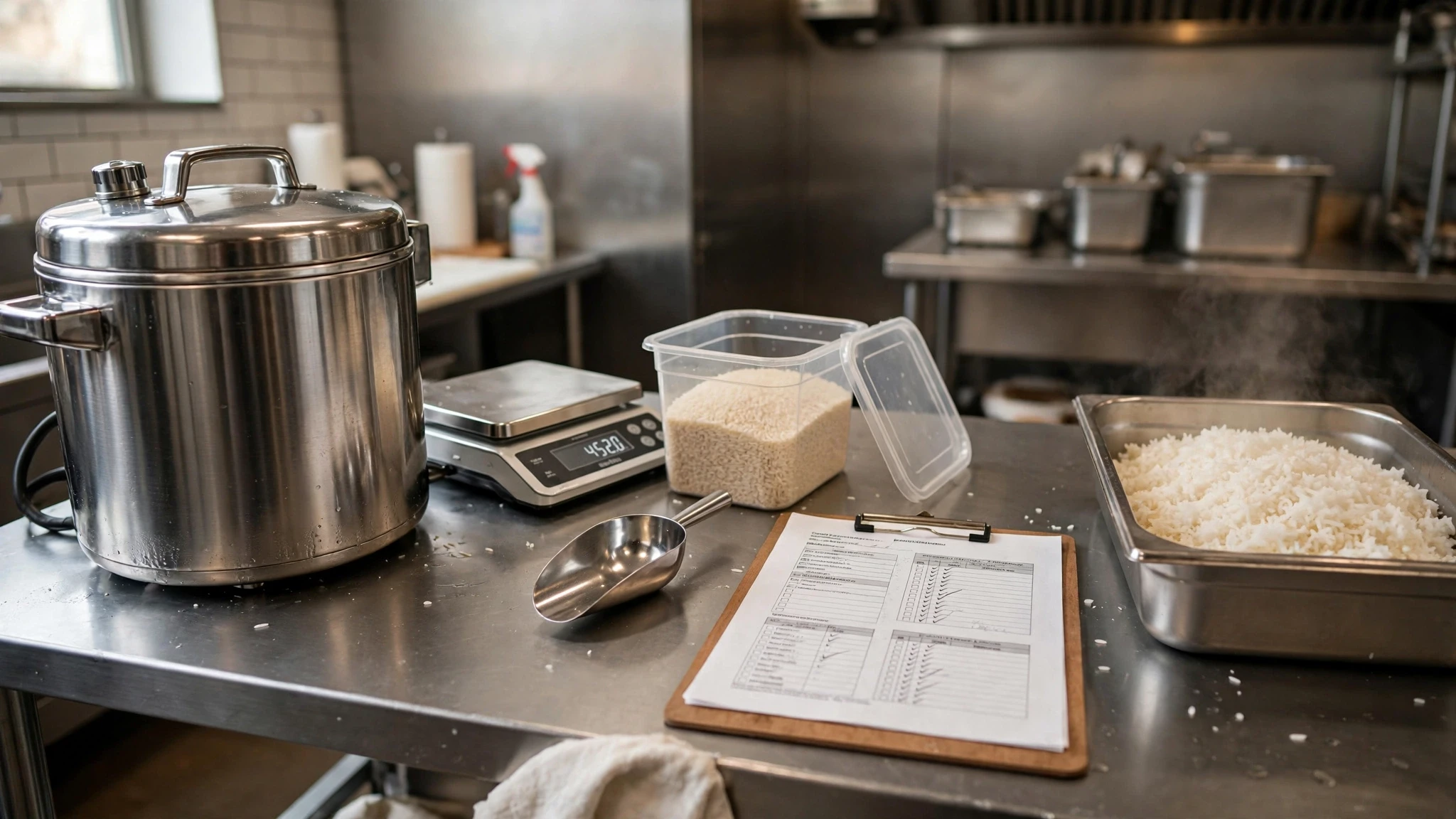
Rice batch yield control connects production, portioning and costing to one measured standard: raw input, approved method, finished usable yield and standard portion.
Define the exact rice specification
Record the rice type, supplier specification where relevant, pack unit and recipe version. Long-grain white rice, basmati, jasmine, par-cooked rice and specialty blends do not necessarily behave the same.
Do not treat a supplier substitution as equivalent until the restaurant confirms the product still performs to the required yield and quality standard.
Measure raw input consistently
Use a controlled weight or volume method. Weight is often easier to compare across batches because cup measures can vary with packing and container shape.
If the existing recipe is written in volume, the restaurant can still test it, but the same measuring tool and fill method should be used during the test.
Standardize process variables
- Rinsing or soaking step if part of the approved recipe.
- Rice-to-liquid quantity.
- Cooking vessel and batch size.
- Heat/program setting where equipment allows.
- Cook and rest sequence under the approved recipe.
- Fluffing/mixing method.
- Final additions such as oil, butter, seasoning or garnish.
- Holding method under the restaurant’s approved food-safety process.
The purpose is not to claim one universal rice method. It is to reduce variation inside this restaurant.
Measure finished usable yield
After the approved process is complete, weigh or measure the finished usable batch before service losses begin.
Do not count scorched product, product discarded for quality reasons or residue that cannot be portioned as usable yield.
Yield percentage by weight can be expressed as finished usable weight divided by raw rice weight × 100, but for operations the more important figure is often total finished kilograms and standard portions per batch.
Calculate portions per batch
Portions per batch = finished usable quantity ÷ standard portion quantity.
Illustrative example: a finished batch weighs 12.0 kg and the approved side portion is 200 g. Theoretical usable portions = 12,000 g ÷ 200 g = 60 portions.
That is an example of the calculation structure, not a recommended restaurant portion size.
Verify the actual serving tool
If the approved portion is 200 g but the normal scoop delivers 235 g, the recipe’s theoretical yield is not the service yield.
Weigh several normal scoops during a controlled check. If the tool and standard do not align, either change the tool/technique or deliberately revise the portion standard.
Test more than one batch
One batch can be unusually good or poor. Test several normal production runs by different trained employees where practical.
Use the spread between batches to identify whether the written process is actually reproducible.
Create a rice yield record
| Field | What it shows |
| Recipe/version | which standard was used |
| Raw rice quantity | controlled starting input |
| Liquid quantity | key process input |
| Finished usable yield | actual result |
| Target portion | service standard |
| Expected portions | yield ÷ portion |
| Actual portions issued/sold | service reality where measurable |
| Variance note | why actual differs |
Separate cooking yield from service variance
A batch can hit the target cooked yield and still disappear too quickly because service portions are too large. It can also miss the cooked-yield target even when portioning is perfect.
Keep these as separate questions: Did the kitchen produce the expected usable quantity? Did service issue that quantity at the expected portion?
Calculate cost per usable portion
Batch ingredient cost should include the controlled recipe inputs the restaurant chooses to treat as direct batch cost.
Cost per usable portion = batch ingredient cost ÷ usable standard portions.
If finished yield falls while ingredient cost stays the same, cost per portion rises automatically.
Include finishing ingredients
If rice is finished with butter, oil, stock, herbs or another ingredient, include those in the approved recipe and costing rather than treating them as invisible kitchen additions.
Plan production from portions, not pots
Forecast rice portions by daypart, menu mix, catering commitments or other relevant demand. Then convert required portions into tested batch units.
A ‘full pot’ is only a valid planning unit when the full pot has a documented usable yield.
Use partial batches only when tested
Half batches or other scaled batches can behave differently in some equipment. If the restaurant regularly uses them, test and document the scaled version rather than assuming the full-batch yield scales perfectly.
Control rice used in multiple menu roles
Rice may be a side, bowl base, catering component or ingredient in another production item. Separate these uses when demand planning so one channel does not silently consume the stock planned for another.
Check hold and carryover losses separately
Rice remaining after the production window should be handled under the restaurant’s approved food-safety and quality procedures. Do not blend carryover assumptions into cooked yield.
Yield measures what the batch produced. Waste/carryover measures what happened afterward.
Example: food price is stable but portion cost rises
A restaurant’s rice purchase price is unchanged. Yet the side’s cost per portion rises. Batch records show finished yield has fallen from around 12 kg to 10.8 kg while the same raw quantity is used.
Management now investigates process consistency—liquid, cooking, sticking, hold loss or discarded product—rather than blaming supplier price.
Example: yield is right but the batch runs out early
Three tested batches repeatedly deliver about 60 standard portions. On busy nights the kitchen runs out after roughly 50 orders. Spot checks show the normal scoop is delivering materially above the approved portion.
The correction belongs in portion execution, not in adding another rice batch to the forecast.
Manager weekly check
- Recent tested yield versus standard.
- Difference between cooks/equipment shifts.
- Actual serving-tool weight.
- Portions forecast versus portions issued.
- Unexplained rice waste.
- Supplier/spec changes.
- Cost per usable portion.
- Need to revise recipe, tool or batch size.
Common rice-yield mistakes
Using raw-to-cooked rules from the internet
The restaurant’s rice, equipment and process may produce a different result.
Measuring only the pot volume
Variable fill and product density make comparisons unreliable.
Ignoring finishing ingredients
The recipe and cost sheet do not describe the actual product.
Blaming demand for an under-yielding batch
The forecast is changed when the production standard is the real problem.
Assuming one scoop equals the standard
Portion variance consumes the batch faster than planned.
Frequently asked questions
How much cooked rice should one kilogram of raw rice produce?
Test the restaurant’s actual rice, equipment and approved process. Do not use a generic yield as the exact operating standard.
Should restaurants measure rice by weight or volume?
Either can work if controlled, but weight often makes batch-to-batch comparison and costing easier.
How many test batches are enough?
Use enough normal production runs to confirm the result is repeatable across typical staff/equipment conditions. Retest after a meaningful product or process change.
Does leftover rice count as yield?
Finished usable product is part of production yield, but what happens to remaining product afterward should be tracked separately under approved food-safety and waste procedures.
Next action
Test the next three normal rice batches. Record raw input, finished usable weight and the weight of the actual serving scoop. If recipe yield and service yield disagree, fix that gap before changing the par or menu price.
Related guides:
- Restaurant Recipe Yield Test: How to Calculate Edible Yield and True Ingredient Cost
- Restaurant Portion Control: How to Standardize Serving Sizes and Protect Food Cost
- Batch Recipe Production: How to Scale, Stage and Control Large-Batch Prep
- Restaurant Recipe Costing: How to Calculate the True Cost of Every Dish