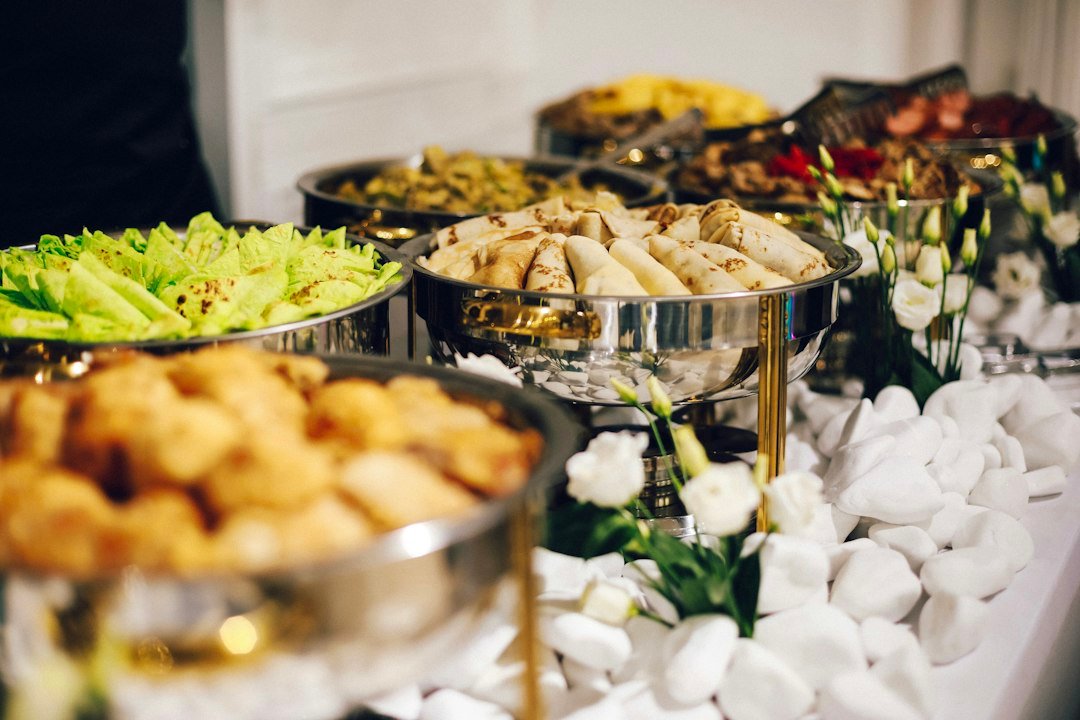
A profitable buffet does not have to look half-empty or produce rows of untouched food at breakdown. The control is to plan portions from the guaranteed guest count, hold a protected reserve, and refill the display in quantities that reflect actual guest flow and the time remaining. That avoids opening an entire final pan merely to serve a handful of people.
For a 150-guest catered event, 15 unnecessary portions at a hypothetical ingredient cost of $3.20 each represent $48 of direct ingredient exposure if those portions are actually wasted. The relevant question is not whether a catering operator can eliminate every leftover portion; it is how to serve the contract safely and consistently with less avoidable production and display waste. The dollar figures below are illustrative, not typical catering-industry benchmarks.
Start with guest count, menu choice and portion demand
Separate guests attending from portions required. A 150-person buffet might have three entrées and four sides. It would be a mistake to produce 150 full portions of each entrée if most guests take one entrée and smaller samples of others. It would also be risky to forecast all items as if every attendee will take a single identical plate. Gather menu selections, service type, age mix when relevant, dietary requests, past comparable events, and the signed minimum or final guarantee.
Maintain an event-specific production model with the following distinct terms:
- Guest guarantee: the number the client has formally committed to paying for, which may not equal guests who actually attend.
- Expected demand: your best estimate of individual menu-item portions, based on a comparable event and a documented assumption.
- Authorized buffer: additional service capacity explicitly approved to protect guest experience.
- Service-ready stock: portions safely presented on the buffet right now.
- Protected reserve: prepared food held under the appropriate food-safety controls and not exposed to guests.
The portion plan should be included in the banquet event order (BEO) and translated into kitchen batches through the catering production sheet.
A worked 150-guest buffet forecast
Assume an event offers one main entrée and two alternate selections. The following is a hypothetical choice-mix example based on 150 anticipated guests; actual quantities must account for seconds, guest demographics and the agreement.
| Entrée | Expected choice share | Demand estimate | Example authorized buffer | Total prepared portions |
|---|---|---|---|---|
| Chicken | 60% | 90 | 8 | 98 |
| Vegetarian | 25% | 37.5, round to 38 | 4 | 42 |
| Fish | 15% | 22.5, round to 22 | 3 | 25 |
| Total | 100% | 150 | 15 | 165 |
Rounding conventions matter: 37.5 and 22.5 cannot both be rounded upward if the base plan is 150; here they become 38 and 22. A 15-portion buffer corresponds to 10% of estimated one-entree demand in this scenario. That number is not a standard recommendation and may be inappropriate for a contract requiring guaranteed menu choice availability. Rebalance the mix using confirmed vegetarian/allergen requests rather than sacrificing those meals to avoid leftovers.
Choose a refill trigger that reflects demand, not appearance
Instead of opening all 165 portions at the start, divide the menu into service pans and protected reserve containers. Suppose chicken is staged in 15-portion pans. At the event start, only the display quantity appropriate to forecast early arrivals is placed into compliant hot holding. A reserve pan is prepared or maintained under an approved method. The service lead checks consumption every 10–15 minutes during the rush, documenting the time and pan quantities. The frequency is a management choice, not a food-code holding interval.
A practical refill decision compares three quantities:
Refill requirement = expected portions for the remaining service window + explicit service buffer − safely available display portions.
Imagine there are 25 minutes left, projected demand is eight chicken portions, and five usable servings remain on the display. If management reserves a three-portion final buffer, the immediate refill requirement is 8 + 3 − 5 = 6 portions. Opening a 15-portion pan without justification may create up to nine excess display portions if demand matches the estimate. A smaller replacement pan or a carefully staged partial refill may be more appropriate, provided handling and temperature controls are satisfied.
Service-ready and protected reserve food are not interchangeable
Food presented to guests is exposed to a different contamination risk from food held safely in a protected reserve. Do not return a buffet pan to the kitchen and treat the contents as untouched backup inventory merely because it appears full. Require the event captain to identify which containers entered guest service, which remained protected, and which must be discarded under your approved food-safety policy. An unused reserve also needs proper time, temperature, label and holding records before any future use; it is not automatically safe to rework.
As of November 2026, the latest national model is the 2026 FDA Food Code. Under its model holding provision, section 3-501.16, time/temperature control for safety (TCS) food generally must be held at 135°F or hotter for hot holding or 41°F or colder for cold holding, subject to specified exceptions. A food business using time as a public health control must meet section 3-501.19 conditions, which include specific written procedures, time marks and discard rules. Never assume that a buffet can sit at room temperature until the event ends simply because service is short. The adopted state/local food code and approved event plan govern.
Budgeting the actual loss, not an imaginary selling-price loss
Suppose the chef prepared 15 buffer portions at a hypothetical cost of $3.20 in direct ingredients each, but the final demand proved exactly equal to base forecast and all 15 were discarded. Direct ingredient exposure is 15 × $3.20 = $48. It is not 15 times the quoted buffet price per guest; that menu price includes service, facilities, rental costs and other elements. Labor already paid to prepare the food does not become a newly avoided cash expense unless scheduling or overtime actually changes.
Now suppose a smaller final refill reduces unnecessary production by eight portions across eight comparable events in one month, with no shortage complaints or new labor cost. The modeled direct input saving is 8 × 8 × $3.20 = $204.80. That is only an estimate until the purchasing and inventory records show less ingredient consumption. If late refills instead trigger additional transport, emergency preparation or guest compensation, deduct those costs from the benefit.
The cost of running out can exceed the cost of a small buffer
Not every decrease in leftover food is a success. A caterer that consistently empties the buffet ten minutes early may save ingredients while failing to honor a contracted guest experience. Track stockout incidents, service wait time, guest complaints and emergency replacements alongside food waste. An appropriate buffer protects the event promise, and a well-designed final-refill decision protects both the experience and the margin.
When a guest requests an additional special-diet portion, verify allergens and actual availability through trained staff; do not replace it casually with a visually similar entrée. Communication and safe service override a narrow food-cost target.
Operational roles and handoffs
| Role | Before guests arrive | During service | After service |
|---|---|---|---|
| Sales/event manager | Confirm guest guarantee, meal choice, service duration | Approve paid scope changes | Record client issues |
| Kitchen lead | Build batch plan and protected reserve | Release additional prepared portions safely | Reconcile produced versus consumed |
| Buffet captain | Confirm pan counts, allergen labels, temperature setup | Record refill times and hot/cold holding checks | Count display leftovers and discard |
| Finance/owner | Approve cost envelope | Escalate exceptional expense | Analyze gross margin and recovered credits |
Copy-ready buffet refill log
| Field | Example / purpose |
|---|---|
| Event / date / menu item | EV-201, chicken entrée |
| Guest guarantee | 150, with documented choice mix |
| Total prepared | 98 chicken portions in this example |
| Opening display | Record container count and safe holding temperature |
| Protected reserve | Count unopened, correctly held portions |
| Refill action | Time, number released, authorizing staff |
| Customer service incidents | Stockouts, waits, substitutions, allergy issues |
| End-of-service dispositions | Served, safely retained under policy, discarded, other |
| Final variance | Prepared − served − documented other disposition = difference for investigation |
How to use results to forecast the next event
- Review the previous three to six comparable events with similar menus, guest mix and service durations.
- Calculate actual portions served per guest for each dish; do not treat pans opened as servings sold.
- Examine why leftover quantities arose: inaccurate guest count, poor choice mix, oversized final pan, inconsistent portions or too much reserve.
- Change one assumption at a time, such as late-service pan size, then record the effect on waste and guest complaints.
- Keep the first-batch budget and the late-stage refill decision separate so managers can manage demand without altering the signed contract in the moment.
For broader food-waste policy, the EPA Wasted Food Scale emphasizes preventing surplus food before it is created. Safe donation or other recovery options must follow applicable food-safety and recipient rules; they do not justify retaining exposed buffet food that must be discarded.
Frequently asked questions
Should a buffet display be full until the last minute?
No. A well-presented smaller pan can look attractive while avoiding unnecessary end-of-service exposure. The display must still meet the contracted service standard and food-safety requirements.
Can unused buffet food be reused for another event?
Do not assume so. Guest-exposed food and safely controlled reserve food have different contamination histories. Follow the food authority’s rules and your approved disposition procedure; document decisions rather than making them from appearance.
How much extra should a caterer prepare?
There is no single safe percentage for all menus. Derive the buffer from contract guarantees, actual comparable demand, possible seconds, special meals, menu mix and lead times. Test its effect on both waste and shortages.
Should a buffet variance be measured in dollars or portions?
Both. Portions explain operational causes; direct unit costs translate actual waste into expense. Do not multiply all unused portions by the menu selling price and call that a cash loss.
Related guides and references
Link the forecast to catering food quantity planning per guest, the production sheet and dispatch guide, and the catering event profitability review. Food-safety model: FDA Food Code 2026, sections 3-501.16 and 3-501.19. EPA source: Wasted Food Scale research. All numeric quantities, percentages and per-portion costs are training assumptions, not quotes or industry averages.
Featured photograph by Saile Ilyas via Unsplash, used under the Unsplash license.