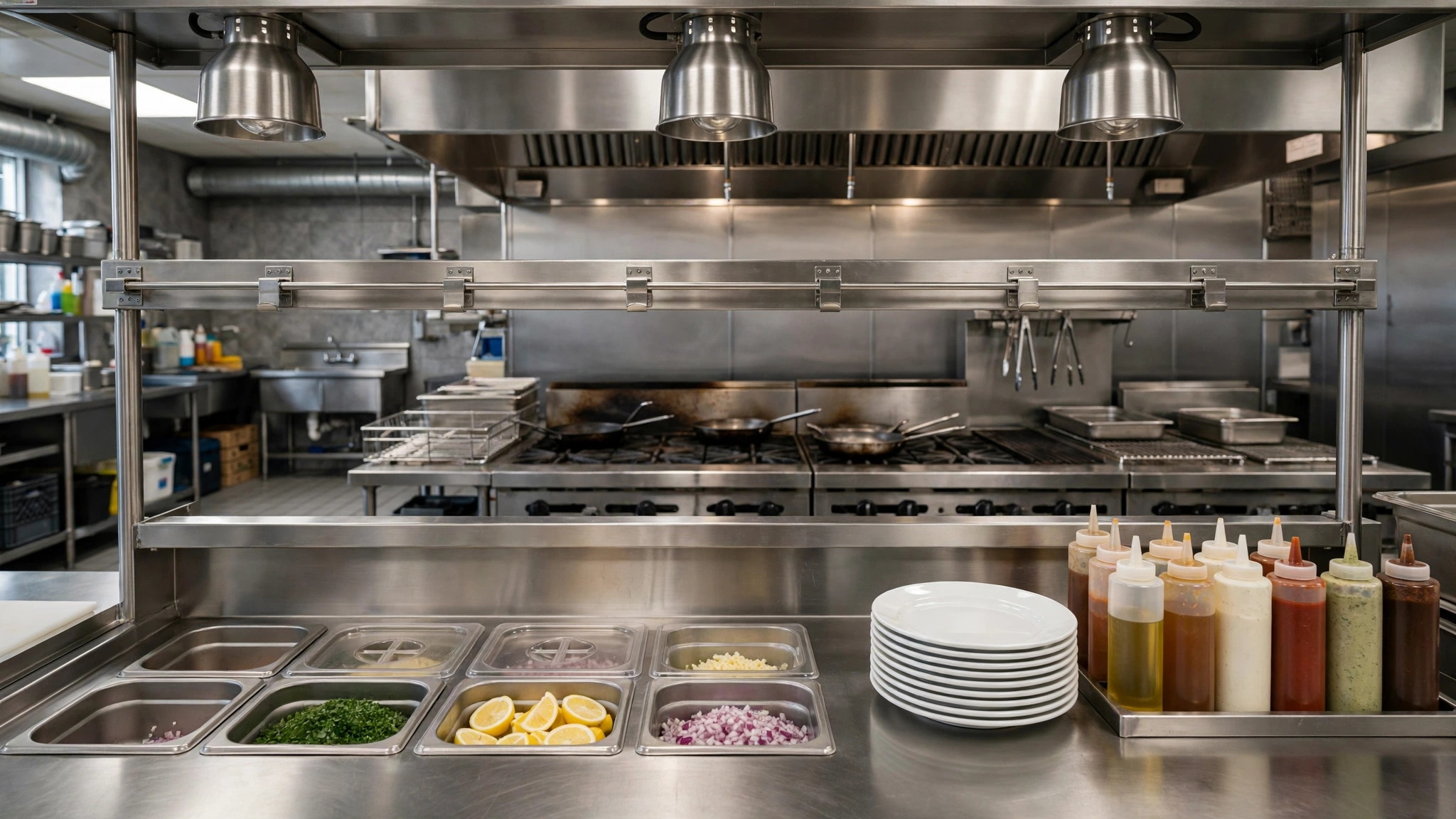
The expo station is where a restaurant discovers whether all the work before it actually became a complete order.
The grill can cook correctly, the fry station can hit its time, the pantry can plate cleanly and the kitchen can still send a poor order if the final handoff is uncontrolled. One side is missing. A modification is overlooked. Two plates for the same table leave three minutes apart. A delivery bag is sealed before the drink or sauce is checked. A server takes the wrong plate because nobody clearly owns the pass.
Expo control is the operating system for that final coordination point.
It is not simply “someone looking at plates.” A good expo process controls ticket sequence, order completeness, communication, final quality checks and handoff ownership without becoming a second kitchen manager shouting at every station.
Define what expo owns
The expo role should be explicit.
Typical responsibilities can include:
• monitoring ticket sequence,
• coordinating when components need to meet,
• confirming modifiers and special instructions,
• checking that the order is complete,
• confirming plate or package identification,
• coordinating remakes and missing components,
• controlling the handoff to servers, runners or delivery packing,
• escalating a service-risk delay.
What expo should not do is equally important.
If the expo person is constantly leaving the station to find garnish, refill ramekins, run food, answer the phone and solve unrelated staffing problems, the control point disappears during the exact period when it is most needed.
Build the station before the first ticket
Expo problems often begin before service.
A pre-service check should confirm the basics:
• ticket printer or display is working,
• backup paper or system process is ready if used,
• pass surface is clear,
• required plates, trays or packaging are available,
• common condiments and finishing items are stocked,
• order identifiers are clear,
• heat-lamp or holding equipment is operating according to the restaurant’s approved process,
• runners or servers know the handoff rule,
• high-risk modifiers or special instructions have a clear communication path.
This is a readiness check, not a deep cleaning routine.
Related readiness guide: Restaurant Pre-Service Readiness Checklist Before Opening
Use one visible ticket sequence
The expo station should have one authoritative view of active orders.
Depending on the restaurant, that may be:
• a kitchen display system,
• printed tickets,
• a combination of display and paper,
• a service screen integrated with the POS.
The technology matters less than the control rule: staff should know which view determines the active sequence.
If the grill follows one screen, pantry follows a second filtered view and expo relies on printed tickets without a consistent routing rule, the team can all be “correct” and still build the order in the wrong sequence.
KDS workflow guide: Restaurant KDS Workflow: Ticket Routing and Priorities
Separate ticket age from order readiness
The oldest ticket is not always the next order that can leave.
Expo must know the difference between:
• ticket age,
• component readiness,
• guest/course timing,
• remake status,
• service priority under the restaurant’s defined rules.
The objective is not random reprioritization. The objective is to prevent one late component from causing uncontrolled movement around the pass.
When an order cannot leave, mark the reason clearly.
Examples:
• waiting on grill,
• remake in progress,
• guest timing hold,
• packaging incomplete,
• modifier clarification,
• runner unavailable.
That turns “Where is table 18?” into a specific operating question.
Control modifications at the final handoff
Modifiers are a common failure point because they can be visible to the station that produced the item but not to the person who completes the order.
Expo should have a clear way to identify instructions such as:
• no ingredient,
• add-on,
• side substitution,
• cooking preference,
• packaging instruction,
• seat or guest position where the restaurant uses it.
Allergen and food-safety instructions require the restaurant’s approved procedures and applicable local requirements. A generic expo checklist should never replace those controls.
The operational rule is simple: a modification should remain visible until the order is handed off correctly.
Build a complete-order check
A complete-order check can be short enough to use during peak service.
For dine-in:
1. correct table/order,
2. correct number of items,
3. modifiers visible and confirmed,
4. required sides/condiments present,
5. plate presentation acceptable under the restaurant’s standard,
6. runner/server takes the correct order.
For takeaway or delivery, add packaging-specific checks.
Delivery accuracy guide: Restaurant Delivery Order Accuracy: How to Reduce Missing Items and Wrong Orders
The point is not to read a six-line checklist aloud on every plate. The point is to train a consistent scan pattern so the same errors are not rediscovered by the guest.
Use closed-loop communication for missing components
Weak callout:
“I need fries!”
Better communication identifies the order and expected response:
“Table 12, one fries missing.”
The station acknowledges:
“Table 12 fries, two minutes.”
Expo now has an owner and an expected time.
This reduces repeated shouting and helps expo decide whether other components should wait, be remade or be handled under the restaurant’s service standard.
Do not let the pass become uncontrolled holding space
A crowded pass creates several risks:
• plates lose their ticket identity,
• the wrong runner takes an order,
• hot and cold components wait unnecessarily,
• remakes become confused with original items,
• completed orders block visibility of new orders.
Use zones if the volume justifies them.
For example:
| Zone | Purpose |
|---|---|
| Building | Order still waiting on components |
| Check | All components present; expo verifying |
| Ready | Cleared for immediate handoff |
| Exception | Remake/clarification/hold |
The physical layout can be different. The useful idea is to separate normal flow from exceptions.
Protect expo from unnecessary side work
During peak service, expo should not become the default person for every missing supply.
If the station repeatedly runs out of sauce cups, garnish, bags or printer paper, solve that through pre-service pars and replenishment ownership.
Otherwise, the restaurant pays twice:
• the supply was not prepared correctly,
• the coordination role is pulled away to fix it.
This is one reason line readiness and expo readiness should connect.
Kitchen line readiness: Restaurant Kitchen Line Readiness: A Station-by-Station Pre-Service Check
Define the handoff rule
The order is not complete when the final plate touches the pass. It is complete when responsibility transfers clearly.
A handoff rule may specify:
• who can take food from the pass,
• whether expo calls the table/order number,
• whether the runner repeats the number,
• how seat positions are communicated,
• what happens when the assigned server is unavailable,
• how delivery/takeaway orders are transferred to packing or pickup.
Avoid a pass where anyone can grab anything because it “looks like their table.”
Worked example: one late component on a six-top
Assume a six-top has:
• two burgers,
• one chicken plate,
• one pasta,
• two salads.
Five items arrive at expo. One burger is still two minutes out.
A weak process has three possible failures:
• five plates leave and one guest waits,
• five plates sit without anyone knowing why,
• stations start remaking items because staff think the order was lost.
A controlled process is:
1. Expo identifies the missing burger and marks the order as waiting on grill.
2. Grill confirms the expected time.
3. Expo evaluates the waiting components under the restaurant’s service and quality standard.
4. Runner is told the order is not yet released.
5. When the burger arrives, expo performs the complete-order check and releases the table once.
The correct decision about whether to hold, refire or sequence components depends on the restaurant’s product standards. The control is visibility and ownership.
Track expo errors by type
“Kitchen mistake” is too broad to improve.
Use a short reason set, such as:
• missing item,
• wrong modifier,
• wrong table/order,
• remake not linked to original ticket,
• late component,
• runner handoff error,
• packaging omission,
• duplicate production.
After several shifts, the team can see whether the problem starts at the station, the ticket routing, the expo check or the handoff.
Use ticket time carefully
Expo can help explain ticket-time problems, but it should not manipulate the metric.
A restaurant should know what its system is measuring:
• order entered to first item,
• order entered to all items ready,
• station bump time,
• expo bump time,
• handoff time.
If staff bump tickets early just to make the screen look better, the metric loses operational value.
Ticket-time guide: Restaurant Kitchen Ticket Time: How to Measure and Reduce Slow Orders
Build a peak-service recovery rule
Eventually, the station will fall behind.
Expo should know the recovery process before that happens.
A practical response can include:
1. identify the oldest true exceptions,
2. stop uncontrolled reprioritization,
3. confirm which station is constraining flow,
4. assign one person to resolve missing components if staffing allows,
5. communicate realistic status to service,
6. protect new tickets from becoming mixed into old exceptions,
7. clear the pass in controlled order.
The goal is not “work faster.” It is restore sequence.
Decide when a manager should step in
Expo needs authority within a defined boundary.
Manager escalation may be appropriate when:
• a delay threatens a major service failure,
• a guest-impacting remake is repeated,
• a system outage affects routing,
• a food-safety or allergen issue requires the restaurant’s formal process,
• multiple stations are unable to recover,
• a staffing problem leaves expo unmanned.
Do not make the expo person wait for manager approval on routine sequencing decisions if the role is supposed to coordinate service.
Measure whether expo control is working
Useful internal measures can include:
• orders returned for missing components,
• remake count by reason,
• order handoff errors,
• late-component frequency,
• delivery/takeaway omission rate,
• ticket-time exceptions connected to expo,
• number of peak periods where expo loses a dedicated owner.
These are internal trend measures, not universal industry benchmarks.
The strongest sign is fewer avoidable surprises at the handoff.
Common expo-station failures
Expo becomes a garnish station
The coordinator spends the shift producing instead of controlling flow.
Everyone can remove plates
Order identity disappears at the final handoff.
Remakes are not linked to the original ticket
Duplicate or incomplete orders become more likely.
Modifiers disappear after the station bumps the item
The final checker no longer sees the special instruction.
The pass holds too many unresolved orders
Normal flow and exceptions become mixed together.
Ticket time is treated as the only goal
Staff optimize the screen rather than the guest handoff.
A practical expo routine by phase
Before service
Check the station, routing, supplies, runner rule and exception process.
Early service
Confirm tickets are routing correctly and modifiers are visible.
Peak
Protect sequence, control exceptions and keep the handoff clear.
Recovery
Resolve old exceptions deliberately rather than reshuffling every ticket.
Close
Review the largest service failures and restock the station for the next shift.
Frequently asked questions
Does every restaurant need a dedicated expo person?
No. The role can be combined in lower-volume periods. The important point is that someone clearly owns final coordination when order complexity or volume requires it.
Should expo cook or plate food?
That depends on the operation. During peak periods, too much production work can weaken the coordination role. Define the boundary based on volume and staffing.
Is expo responsible for ticket time?
Expo influences flow but does not control every production step. Ticket time should be diagnosed by station, routing, demand, staffing and handoff—not blamed on one role.
Should servers take food directly from stations?
Only if the restaurant’s operating model is designed that way. If expo is the control point, bypassing it defeats the final completeness check.
How should delivery orders be handled?
Use a defined packing and handoff process that keeps the order identity visible until the package is complete and transferred correctly.
Five-step implementation sequence
- Define the expo role for normal and peak service.
- Standardize ticket reading, plate checks and final handoff language.
- Set clear rules for modifiers, remakes, missing items and delayed components.
- Measure repeated handoff failures by cause rather than blaming speed alone.
- Recheck the system during the busiest service period and adjust station ownership.
Expo manager checklist
- One person owns final ticket and plate verification.
- Modifiers are visible before food reaches the pass.
- Missing components have a named recovery owner.
- Remakes are communicated to both kitchen and service teams.
- Recurring expo failures are reviewed after service.
Next action
Watch one peak period from the pass without changing the process. Record every time an order waits because the team does not know what is missing, who owns it or whether it is ready. Those moments are the first expo controls to define.