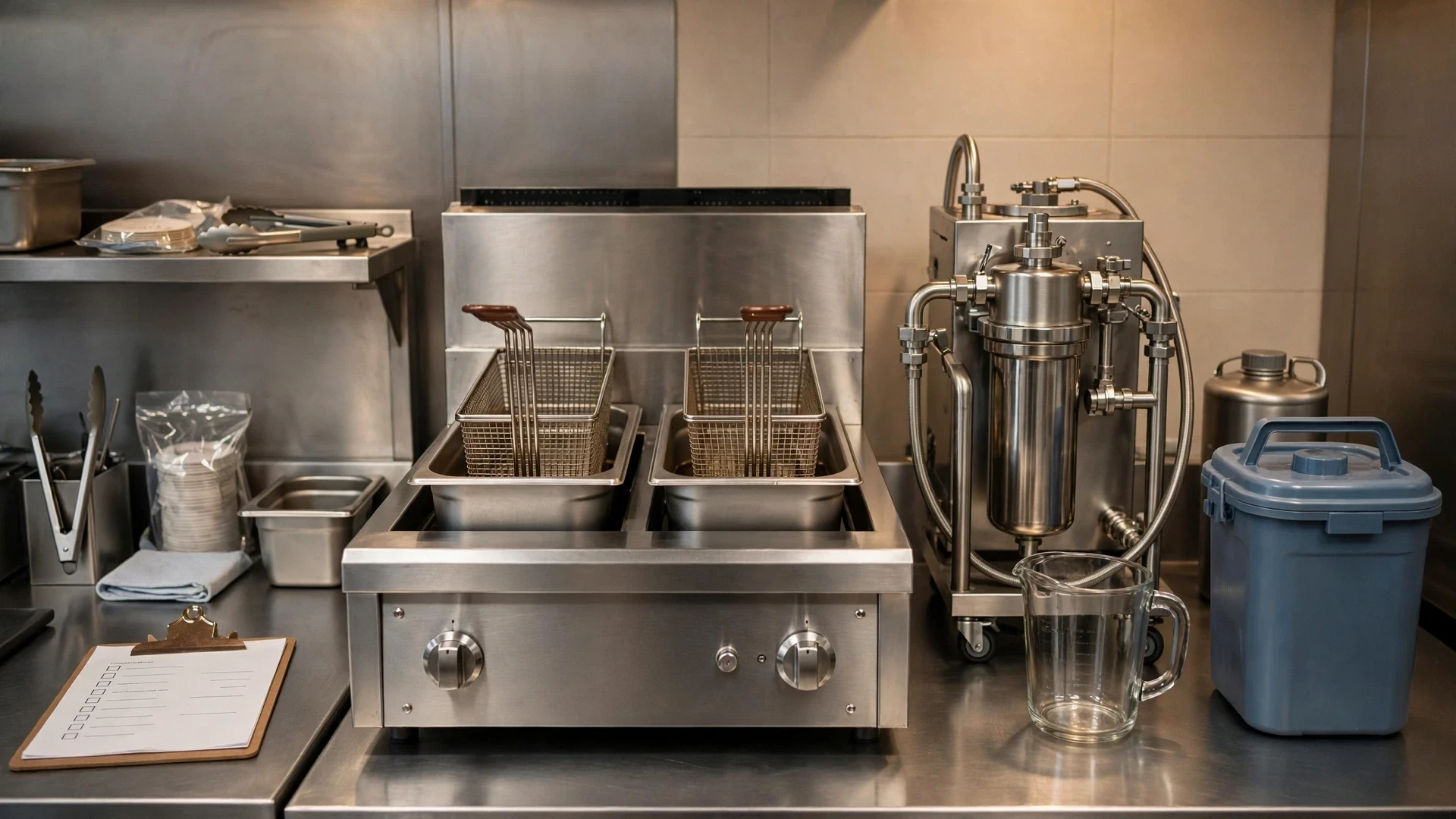
Frying oil is often treated as a kitchen supply instead of a controlled food-cost input. Cases are purchased, fryers are filled, staff top them up, oil is filtered or discarded, and the expense appears later in purchasing without a clear explanation of how much oil each fryer or menu category actually consumed.
That makes oil cost difficult to manage. A restaurant may blame supplier price when the bigger problem is excess top-up, poor filtration practice, crumbs and contamination, leaking equipment, unnecessary hot idle time, overfilled vats or replacing oil without a consistent quality decision.
Frying-oil control starts by treating oil as inventory that moves through a measurable cycle: purchase, fill, top-up, filtration/recovery, production use and disposal.
Separate purchase cost from usage
The amount of oil purchased in a week is not automatically the amount consumed in that week. Deliveries can build inventory, and existing stock can be used before the next purchase.
Track beginning oil inventory + purchases − ending oil inventory to estimate oil issued/used before adjusting for any known transfers or other uses.
Create a fryer oil log by vat
| Field | Purpose |
| Fryer/vat ID | connects usage to equipment and menu demand |
| Opening fill | starting oil quantity or standard fill reference |
| Top-up quantity | oil added during the shift/day |
| Filter cycle | when filtration was completed |
| Quality check | restaurant’s approved observation/test |
| Replacement quantity | oil removed and new oil added |
| Disposal amount | quantity sent to used-oil system |
| Reason/notes | spill, leak, abnormal degradation, maintenance issue |
The log should be simple enough for normal operations. If staff will not maintain twenty fields, capture the few that explain cost and quality decisions.
Know the standard fryer fill
Each fryer should have a defined operating fill level under the manufacturer’s instructions. The restaurant can convert that fill into a known quantity for cost control.
Do not overfill or underfill equipment to hit a cost target. Equipment operation and safety requirements come first.
Track top-up oil separately
Top-up oil is one of the easiest cost signals to miss. If one vat requires materially more top-up than another with similar sales, investigate product load, crumb generation, filtration loss, leaks, skimming practices and measurement consistency.
The objective is not “zero top-up.” Product carries oil out of the fryer and normal operations can require replenishment. The value is seeing abnormal movement.
Connect oil usage to fried-food sales
A useful internal ratio is oil issued or consumed per 100 fried-item portions, per fryer-hour or per defined sales volume. Choose a denominator that fits the menu and stay consistent.
This is not an industry benchmark. It is a trend that lets the same restaurant compare periods, fryers and menu changes.
Measure oil cost per fried-food category
If fried chicken, fries and appetizers all use the same oil system, allocating exact oil cost to each item can be difficult. Avoid false precision.
A practical approach is to track oil at the fryer or station level and compare it with the contribution generated by the fried-food category. For major products, the restaurant can run controlled tests if it needs a more precise oil-absorption assumption.
Treat filtering as an operating control
The restaurant should follow its equipment, oil supplier and approved operating procedures for filtration and oil management. The cost-control purpose of filtering is to remove contaminants and preserve usable oil quality without extending use beyond the restaurant’s quality or safety standards.
Do not publish a universal number of hours or days that oil “should” last. Menu mix, fryer load, oil type, operating temperature, breading, crumbs, filtration and equipment all change the result.
Record why oil was replaced
- Scheduled quality decision under the restaurant’s oil-management standard.
- Quality result outside the restaurant’s approved limit.
- Product-quality failure.
- Contamination or cross-use issue under the restaurant’s procedures.
- Equipment or filtration problem.
- End-of-cycle planned replacement.
- Unusual event such as water exposure, spill or other incident requiring manager review.
If replacement reason is never recorded, management cannot tell whether shorter oil life comes from product mix, process or equipment.
Use objective checks where the operation supports them
Some restaurants use visual/sensory checks, test strips or electronic oil-quality meters as part of their oil-management program. Whatever method is chosen, train managers on the same standard and follow the device, oil supplier and company instructions.
Do not use a threshold from another restaurant as a universal rule.
Watch crumb load and product mix
Heavy breading, loose flour, seasoning and small food particles can increase contamination in the fryer system. Menu changes can therefore affect oil economics even if supplier price is unchanged.
When a new fried item launches, compare oil usage and replacement frequency before and after the change.
Control cross-fryer transfers
Moving oil between vats can confuse usage data and may create food-quality or allergen-control concerns depending on the menu. If the restaurant permits transfers, record them and follow approved procedures.
Investigate leaks and mechanical loss
Abnormal oil consumption can be equipment loss rather than food absorption. Inspect for leaks, drain-valve issues, filtration-system loss or poor transfer practices. Technical repairs should be handled by qualified personnel as required.
See Restaurant Equipment Maintenance Checklist: Prevent Breakdowns Before Service.
Build a weekly oil reconciliation
- Count unopened oil inventory.
- Add weekly purchases.
- Subtract ending unopened inventory.
- Add/subtract documented transfers if any.
- Compare estimated oil issued with fryer logs.
- Review top-up and replacement by vat.
- Compare usage with fried-food volume or fryer workload.
- Investigate large unexplained differences.
Example: supplier price is not the whole story
Assume oil price rises 8% during the month. Management expects oil cost to rise roughly in that range if volume and operating behavior are stable. Instead, oil spend rises 22%.
The fryer log shows one vat had three early replacements and unusually high top-up. The cause is not solved by negotiating price alone. Management now has a process question to investigate.
Include oil in menu-change decisions
A highly breaded limited-time item can look attractive on ingredient food cost while increasing oil consumption, filtration labor and station congestion. Include the fryer-system effect when reviewing the promotion’s true contribution.
Control used-oil handling
Used oil has operational, safety and sometimes recycling/vendor implications. Follow the restaurant’s approved transfer, storage and collection procedure. The cost article should not encourage staff to carry hot oil, improvise containers or bypass equipment designed for safe handling.
Calculate cost per vat cycle
For management analysis, a vat cycle can be measured from a full replacement to the next full replacement. Add the initial fill plus all top-up oil during that cycle, then multiply by the restaurant’s actual oil cost. This creates a comparable cost for each cycle without pretending to assign every ounce to a specific menu item.
Compare cycle cost with fried-food sales or portions during the same period. A cycle that costs more but supports significantly more productive volume may be more efficient than a shorter cycle with lower absolute spend.
Separate price variance from usage variance
Oil spend moves for two main reasons: the supplier price changes or the restaurant uses more oil. Keep those effects separate.
Illustrative decomposition: if oil unit cost rises 6% but physical oil issued rises 12%, management has both a price problem and a usage problem. Negotiating the vendor price addresses only one side.
Evaluate supplier offers on cost-in-use
The cheapest case price is not automatically the lowest operating cost. Different approved oils may perform differently under the restaurant’s menu, fryer load and filtration system.
If the business evaluates alternatives, run controlled tests using consistent product mix, operating process and quality criteria. Compare case cost, physical usage, replacement frequency and product quality. Do not make claims about oil longevity without your own controlled data.
Include fryer idle behavior in the review
Operational schedules can affect oil degradation and energy use. A fryer left operating during long low-demand periods may behave differently from a controlled daypart shutdown or reduced-load process, depending on equipment and manufacturer guidance.
Any operating change must follow equipment instructions and safe operating procedures. The cost-control point is to connect fryer operating hours with real demand instead of treating every day the same.
Audit filtration loss
Some oil is lost during filtering, transfer and cleanup. Measure that loss periodically. If the filter process repeatedly removes an unusually large amount of usable oil, inspect equipment setup, filter media, transfer technique and staff training.
The goal is not to recover contaminated material. It is to distinguish legitimate removed solids/waste from avoidable transfer loss.
Use waste-oil pickup records as a cross-check
Where the restaurant has a used-oil collection vendor, the pickup history can provide a second signal. It will not perfectly equal kitchen logs because of pickup timing and measurement differences, but large inconsistencies can reveal missing records or unusual disposal.
Keep the used-oil storage and collection process under the restaurant’s safety and vendor procedures; do not improvise hot-oil handling for measurement purposes.
Train to a decision standard
Different cooks may describe the same oil as “fine,” “dark,” or “needs changing.” Management should define the approved decision method, who is authorized to decide, how the result is logged and what happens if quality is uncertain.
Consistent decision authority reduces both premature disposal and overextended use.
Connect fryer maintenance to oil economics
Poor temperature control, damaged baskets, filtration problems, leaking valves or malfunctioning equipment can distort oil usage and product quality. When oil behavior changes suddenly without a menu or volume explanation, include equipment condition in the investigation.
Do not ask kitchen staff to perform technical repairs beyond their training. Record the symptom and use the maintenance process.
Manager checklist
- Standard fryer fill level is known.
- Top-up oil is measured or consistently recorded.
- Filtering follows approved procedure.
- Replacement reason is recorded.
- Used oil is transferred/disposed through the approved system.
- Unusual oil loss triggers equipment/process investigation.
- Oil usage is compared with fried-food demand.
- Menu/promotion changes are checked for oil impact.
Use a manager variance threshold for investigation
The restaurant can define an internal trigger for when oil usage deserves investigation, based on its own historical variance rather than an industry rule. For example, management may flag a week when physical oil issued is materially above the recent range after adjusting for fried-food volume.
The threshold is only a signal. The manager still has to diagnose whether the difference comes from sales mix, top-up, replacement, filtration loss, maintenance, spill or measurement error.
Review opening and closing controls
At opening, confirm fryer identification, fill status and any carryover note from the prior shift. At closing, record unusual top-up, early replacement, equipment concerns and whether filtering or approved shutdown steps were completed.
This creates a handoff between shifts so a manager does not discover on the next day that a vat was replaced early without explanation or that a maintenance issue was already visible.
Do not reward staff for stretching oil life
A cost target should never become an incentive to keep oil in service after the restaurant’s approved quality or operating standard says it should be replaced. Measure cost efficiency together with product quality and process compliance, not as a stand-alone “days per vat” contest.
Common oil-control mistakes
Using purchase dollars as the only metric
Inventory timing and operating usage remain hidden.
Replacing oil on habit alone
Different managers make different decisions without a consistent standard.
Stretching oil life only to reduce cost
Product quality and approved operating standards must still control the decision.
No fryer-level data
One problem vat disappears inside total kitchen oil spend.
Ignoring filtration and equipment loss
Management blames supplier price for a process problem.
Frequently asked questions
How often should restaurant frying oil be changed?
There is no single schedule that fits every operation. Use the restaurant’s approved quality method, oil/equipment guidance, menu load and product standards.
Should oil cost be inside recipe food cost?
That depends on the restaurant’s costing method. Some operators treat it as a shared station cost instead of forcing an unreliable per-item allocation. Be consistent and avoid false precision.
Can filtration reduce oil cost?
A disciplined filtration process can support oil management, but follow approved procedures and do not use filtration as justification to keep oil beyond quality or safety limits.
What should managers investigate first when oil usage jumps?
Check sales/menu mix, top-ups, replacement frequency, filtration loss, leaks, spills and any change in fried products or staff procedure.
Next action
For the next seven days, record top-up and replacement oil by fryer. At the end of the week, compare each vat with its fried-food volume. The fryer with the largest unexplained oil movement becomes the first investigation.
Related guides:
- Restaurant Food Cost Analysis: A Weekly Review System for Operators
- Restaurant Equipment Maintenance Checklist: Prevent Breakdowns Before Service
- Restaurant Promotion Profitability: Measure Discounts, Traffic and Contribution Before Repeating an Offer
- Restaurant Waste Log: How to Track Food Waste and Find Cost Leaks