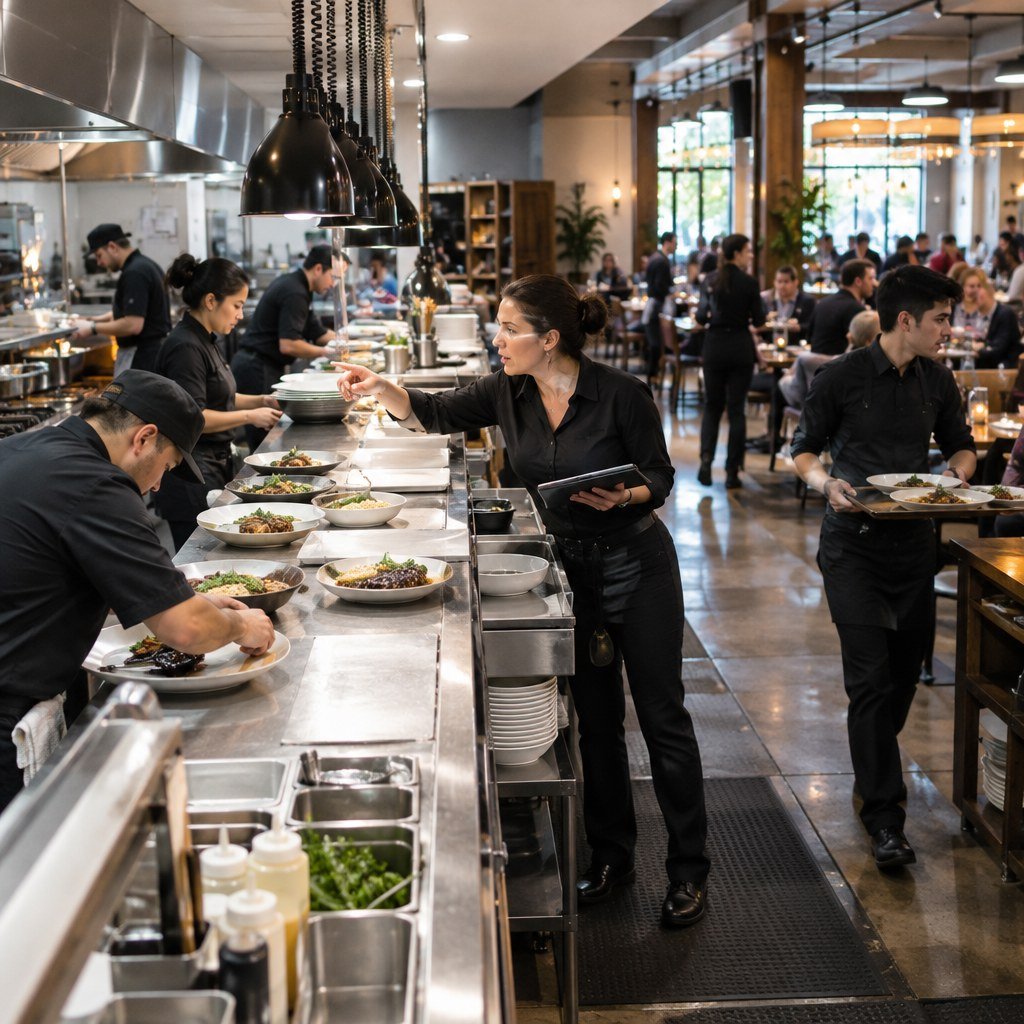
Quick answer: Peak-shift control works best when one manager owns the whole service picture, every critical station has a named owner, problems are escalated by observable triggers rather than emotion, and the team uses a short communication loop: see it, call it, assign it, verify it. The goal is not to eliminate pressure. It is to keep pressure from turning into uncontrolled work.
A restaurant can look fully staffed and still lose control during a rush. The problem is often not headcount. It is unclear command. Hosts keep seating while the kitchen is buried, servers solve the same issue in different ways, managers jump from task to task, and nobody owns the whole flow.
This guide gives restaurant operators a repeatable peak-shift command system that connects the pre-shift briefing, pre-service readiness check, expo station, ticket-time control, guest recovery, manager-on-duty system and manager logbook into one operating rhythm.
What peak-shift command actually means
Peak-shift command is the temporary operating structure used when demand, workload or service risk is high enough that normal individual decision-making needs tighter coordination. It does not mean one manager personally fixes everything. It means one manager keeps the whole system aligned while station leaders handle local execution.
A strong command structure answers five questions at all times:
- Who owns the overall shift?
- Who owns each critical zone?
- What conditions require escalation?
- What is the current bottleneck?
- What is the next recovery action?
If the team cannot answer those questions in a few seconds, the shift is vulnerable to confusion when volume rises.
The peak-shift command map
| Area | Primary owner | What they watch | When they escalate |
|---|---|---|---|
| Front door / host | Host lead or manager | Arrival pace, quote accuracy, table status | Seating pace is outrunning service capacity |
| Dining room | Floor lead | Greeting, drinks, order timing, table recovery | Multiple tables are waiting at the same service step |
| Kitchen line | Kitchen lead | Board load, station backlog, re-fires, product constraints | One station begins controlling total ticket time |
| Expo | Expo lead | Ticket age, completeness, handoff and missing items | Food is waiting, incomplete or repeatedly remade |
| Takeout / delivery | Channel owner | Order queue, pickup timing, packaging accuracy | Off-premise demand starts disrupting dine-in flow |
| Manager on duty | MOD | Whole-system capacity, safety, guest risk and recovery | Any local problem becomes a multi-zone problem |
The important point is that ownership must be visible before the rush. A manager should not discover at 7:20 p.m. that nobody is watching delivery pickup, no one owns the wait list, or two people both think the other person is controlling expo.
Build the shift in three phases
Phase 1: Prepare before demand peaks
The best time to control a rush is before it starts. Use the final pre-peak window to verify the few conditions that can create cascading failure later.
- Confirm station staffing and backup assignments.
- Check high-risk prep, low-stock items and expected substitutions.
- Verify POS, printers, KDS screens and payment devices.
- Confirm the expo position and runner coverage.
- Review reservations, large parties, known delivery surges and local events.
- Identify any equipment restriction that could reduce capacity.
- Set the manager communication channel and escalation language.
The detailed readiness steps belong in the pre-service readiness checklist. Peak command should use that information, not repeat the entire inspection.
Phase 2: Control flow during the rush
Once volume builds, managers should stop managing by anecdote. One loud complaint, one old ticket or one frustrated server can pull attention away from the real bottleneck. The MOD should repeatedly scan the system in the same order.
- Door: What demand is entering?
- Floor: Where are guests waiting in the service sequence?
- Kitchen: Which station is setting the pace?
- Expo: What is waiting to leave the pass?
- Off-premise: Is delivery or takeout consuming shared capacity?
- Recovery: Which guest or operational problem can become expensive if ignored?
This scan can take less than a minute once the habit is established. The purpose is not to create another checklist during service; it is to force the manager to look across the entire operating system before reacting.
Phase 3: Stabilize after the peak
When demand drops, do not immediately return to normal. A restaurant can look calmer while hidden backlog remains in side work, cleaning, restocking, open checks, delayed breaks and unresolved guest issues.
Run a short stabilization check:
- Are all delayed tickets closed or actively owned?
- Are guest recoveries documented and followed through?
- Do stations need a five-minute reset or replenishment?
- Are postponed breaks now covered?
- Did any product, equipment or staffing problem create a risk for the next daypart?
- What needs to go into the manager logbook?
Use trigger-based escalation, not vague urgency
“We are getting slammed” is not a useful operating signal. Managers need observable triggers. A trigger tells the team when local control is no longer enough and another person must act.
Examples include:
- the same station repeatedly becomes the oldest-ticket constraint;
- several tables are waiting at the same step in service;
- food is ready but cannot leave expo;
- a host quote is no longer consistent with actual table availability;
- a delivery queue is blocking dine-in production;
- multiple re-fires begin consuming the same station;
- a critical ingredient or piece of equipment becomes unavailable.
Do not copy arbitrary universal thresholds from another restaurant. The right trigger depends on menu complexity, kitchen design, staffing model and service style. Start with conditions your own managers can observe consistently, then refine them using actual shift data.
The four-step manager communication loop
Peak service gets worse when managers communicate in long explanations. Use a short closed-loop format:
- See it: State the observable condition.
- Call it: Name the operational risk.
- Assign it: Give one person one action.
- Verify it: Confirm whether the action solved the problem.
Example: “Grill is now driving the oldest tickets. We risk stacking expo. Sam, pause nonessential prep and support grill for ten minutes. I’ll check the board again in five.”
That is stronger than “Everybody help the kitchen,” because the action has an owner, a purpose and a recheck.
Protect the bottleneck instead of moving chaos around
Managers often respond to a rush by adding people everywhere. That can make the system slower. A crowded station, unclear handoffs or too many people calling changes can increase mistakes.
When a bottleneck appears, ask:
- Is the constraint labor, equipment, product, sequencing or information?
- Can work be removed from the station rather than adding another person?
- Can another station complete part of the task safely?
- Can the order sequence be simplified without violating guest expectations?
- Should seating, online ordering or another inflow be temporarily moderated?
The ticket-time guide is useful for diagnosing repeated delay patterns after the shift. During the rush, the job is simpler: identify what currently controls flow and protect it.
Do not let the dining room and kitchen operate as separate systems
Many rush failures come from conflicting local decisions. The host tries to reduce the wait by seating faster. Servers try to catch up by sending multiple tables at once. The kitchen sees only the sudden ticket surge. Expo then absorbs the consequence.
The MOD should connect demand to capacity. If the kitchen is losing control, front-of-house decisions may need to change. If the dining room is backing up because food is ready but runners are missing, the kitchen should not be treated as the problem.
This is why the command role needs a whole-system view rather than a permanent station assignment. The table-turn guide can help operators diagnose whether the constraint is seating, ordering, production, payment or reset rather than simply pushing staff to move faster.
Service recovery belongs inside peak command
Guest recovery cannot become a separate side project during a rush. A small unresolved failure can become a larger interruption later. The manager should classify recovery quickly:
| Situation | Immediate action | Follow-up |
|---|---|---|
| Minor delay, guest not yet upset | Acknowledge and set an accurate expectation | Verify delivery |
| Repeated service miss | Manager takes ownership | Track the fix through completion |
| Incorrect or unsafe item | Stop service and correct immediately | Document cause and escalation |
| Escalating complaint | Move from explanation to recovery action | Use the restaurant’s approved authority limits |
For a deeper framework, use the guest complaint and service recovery guide.
A 10-minute peak-readiness huddle
The pre-shift meeting should not become a speech. For a high-risk service period, use a short command-focused version:
- Expected volume and unusual demand.
- Known staffing gaps or new-team-member assignments.
- Menu, stock or equipment constraints.
- Named owners for host, floor, kitchen, expo and off-premise.
- Backup assignments.
- The one or two most likely failure points.
- How the team will call for help.
If the shift has no unusual risks, keep it short. The purpose is alignment, not ceremony.
What the manager should record after the rush
Peak-shift command gets better only when the team learns from repeated friction. Record operational evidence, not blame.
- daypart and approximate peak window;
- main bottleneck;
- trigger that caused escalation;
- action taken;
- whether the action worked;
- guest impact if any;
- staffing, equipment or prep issue to correct;
- owner and recheck date.
Use the manager logbook system to preserve this information across shifts. One isolated bad rush is an event. The same problem appearing repeatedly is a system issue.
Peak-shift command checklist
- One manager owns the whole service picture.
- Every critical zone has a named owner.
- Backup assignments are clear before volume rises.
- The manager scans door, floor, kitchen, expo, off-premise and recovery.
- Escalation uses observable triggers.
- Actions have one owner and a recheck.
- The current bottleneck is protected rather than crowded.
- Front-of-house inflow is adjusted when capacity requires it.
- Guest recovery is assigned immediately.
- The team performs a post-peak reset.
- Recurring failures are logged for follow-up.
Common mistakes
The manager becomes another station employee
Helping is sometimes necessary, but if the MOD disappears into one station for the entire rush, nobody is controlling the overall system. If the manager must jump in, another leader should temporarily own the whole-shift scan.
Every problem is treated as urgent
When everything is urgent, priorities disappear. Separate true flow constraints and guest risks from tasks that can safely wait.
Too many people give instructions
Conflicting direction creates rework. Keep the command path simple and let station owners control their areas.
The team waits too long to call a bottleneck
Early escalation is cheaper than late recovery. Teach employees what condition requires help before the shift begins.
No one verifies the recovery
Assigning an action is not the same as solving the problem. Every critical intervention needs a recheck.
How to review peak performance without blaming the team
The post-shift review should focus on the operating conditions that produced the result. Ask what demand arrived, which constraint appeared first, how quickly the team recognized it, what recovery action was used and whether the issue repeated. Avoid treating one employee’s visible struggle as the root cause before checking workload, prep, equipment, staffing, sequencing and information flow.
For repeated peak failures, compare several shifts rather than one dramatic night. The pattern may show that the same station is overloaded at the same daypart, that breaks are scheduled into the wrong window, that prep is consistently late, or that off-premise demand creates a predictable second queue. That evidence gives managers something they can actually redesign.
FAQ
Who should run peak-shift command?
Usually the manager on duty or another leader with enough authority to change priorities across front-of-house and back-of-house. The person needs a whole-system view rather than ownership of only one station.
Should the manager stay at expo during the rush?
Not automatically. Expo can be the best observation point in some restaurants, but the manager should position themselves where they can see the active constraint and still coordinate the whole operation.
Should restaurants use fixed ticket-time thresholds?
Use thresholds only when they are grounded in your own concept, menu and operating data. A universal number copied from another restaurant can create false alarms or hide real problems.
How do we know whether the rush problem is staffing or process?
Look for repetition. If the same station or handoff fails at similar volume despite different employees, the issue is likely broader than one person. Compare staffing, production load, equipment capacity, order sequence and handoffs before simply adding labor.
What should be reviewed the next day?
Review any repeated bottleneck, unusually old ticket, service recovery, stockout, equipment failure or staffing breakdown. Assign a corrective action, owner and recheck instead of leaving the lesson inside one manager’s memory.
How does peak-shift command differ from the manager-on-duty system?
The manager-on-duty system defines authority and overall shift ownership. Peak-shift command is the high-demand operating mode that the MOD uses when flow needs tighter coordination. The two systems should reinforce each other rather than exist as separate procedures.
Bottom line
A restaurant does not control a rush by asking everyone to work faster. It controls a rush by making ownership, escalation and recovery visible. One leader watches the whole flow, station owners run their zones, the current bottleneck gets protected, and every critical action is verified.
For the next step, connect this system to your pre-shift briefing, readiness check and manager logbook. Those three routines turn peak-shift command from a manager’s instinct into a repeatable operating system.